Huo Hou Alchemical Fire Phasing: Regulating Martial and Civil Breath Dynamics, Energetic Thermogenesis, and Elixir Maturation in Classical Daoist Neidan
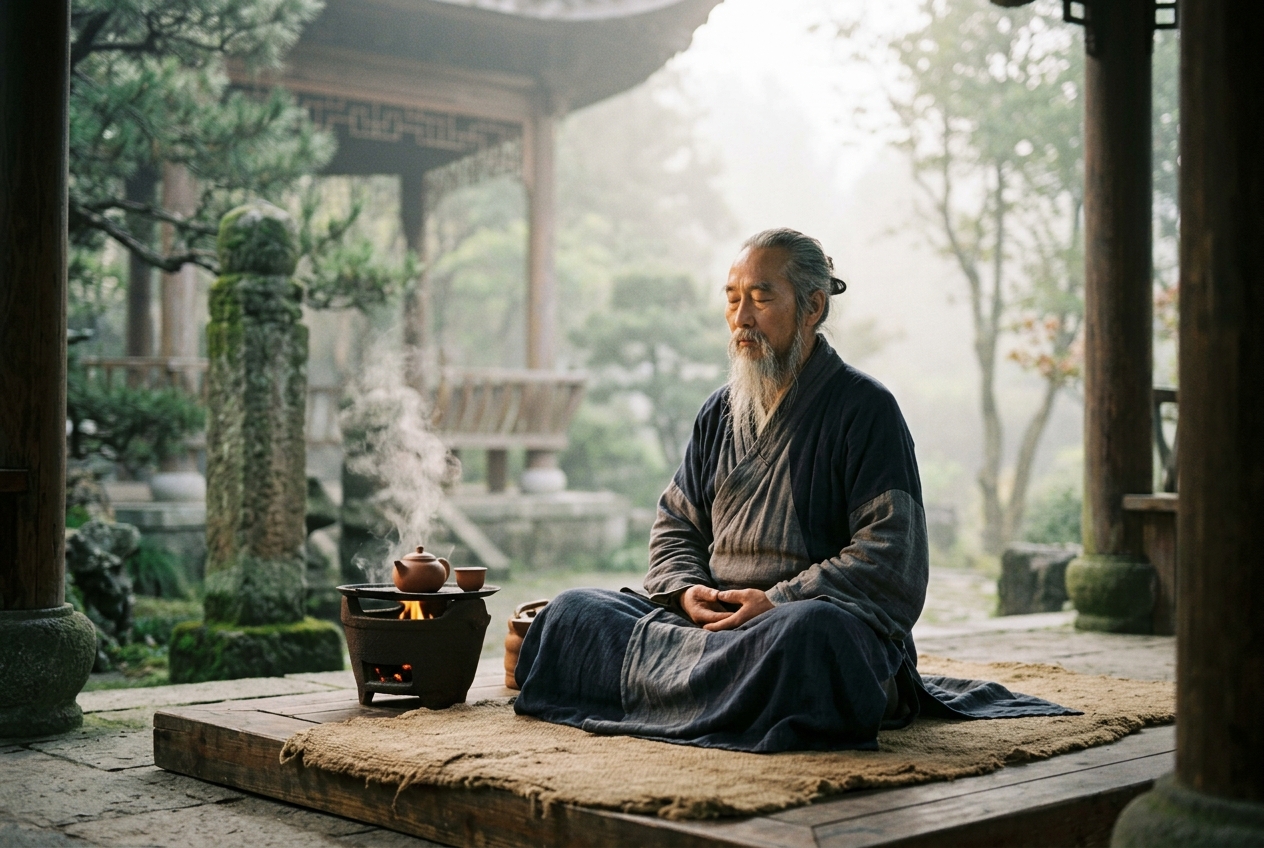
In practical terms, the practitioner works with two foundational modes of respiration and internal mechanics:
- Martial Fire (Wu Huo, 武火): A deliberate, pressurized, diaphragmatic breath cycle that stimulates the sympathetic-adrenal axis, mobilizes microcirculation, increases intra-abdominal pressure, and drives blood and fluid upward along the spinal column.
- Civil Fire (Wen Huo, 文火): An imperceptible, micro-respiratory, parasympathetic state characterized by effortless "embryonic breathing" (Tai Xi), wherein metabolic consumption drops, heart rate variability coheres, and biological tissues undergo deep cellular repair and energetic consolidation.
The mastery of Huo Hou lies not in remaining permanently within one state, but in executing precise, rhythmic transitions between them, synchronizing somatic intention (Yi) with biological feedback.
Step-by-Step Somatic Protocol: Seated and Standing Cultivation
To cultivate Huo Hou safely at home, one must establish an uncompromising biomechanical framework. The following protocol integrates both seated meditation (Jing Zuo) and standing post cultivation (Zhan Zhuang), providing a structured progression from ignition to sublimation.
+-------------------------------------------------------------------------+
|                  SUMMARY OF FIRE PHASING ATTRIBUTES                     |
+-------------------+-----------------------------+-----------------------+
| Attribute         | Martial Fire (Wu Huo)       | Civil Fire (Wen Huo)  |
+-------------------+-----------------------------+-----------------------+
| Respiratory Rate  | 4–6 breaths / minute        | 1–3 breaths / minute  |
| Pressure Dynamics | High Intra-Abdominal (IAP)  | Ambient / Micro-tonal |
| Autonomic Mode    | Controlled Hormetic Accent  | Deep Parasympathetic  |
| Neurological Wave | Beta-to-Alpha Transition    | Alpha-Theta Coherence |
| Somatic Sensation | Radiant Heat, Fullness      | Silken Fluidity, Mist |
| Alchemical Target | Clearing & Spinal Ascent    | Sealing & Marrow Bath |
+-------------------+-----------------------------+-----------------------+
Step 1: Structural Calibration and Crucible Alignment
Whether choosing a seated posture on a meditation cushion or standing in the foundational Wuji stance, your physical architecture dictates fluid dynamics: * Suspension of the Crown (Baihui): Gently lift the crown of your head as though suspended by a fine silk cord from the heavens. Tuck the chin slightly to lengthen the cervical spine and decongest the suboccipital triangle. * Release of the Pelvic Floor (Huiyin): Drop the tailbone downward, softening the lumbar curve (Mingmen flatting). The perineum should feel buoyant—neither gripped nor collapsed. * Chest Sinking (Hanxiong Babei): Relax the sternum inward by two millimeters, broadening the interscapular fascia across the upper back. This disengages superficial thoracic muscles and directs diaphragmatic excursion downward.
Step 2: Igniting the Martial Fire (Wu Huo)
Once aligned, initiate the active phase to clear stagnation and generate core thermogenesis: * The Breath Cycle: Adopt Reversed Abdominal Respiration (Ni Fushi Huxi). As you inhale slowly through the nose over 4 to 5 seconds, gently draw the lower abdomen inward while drawing the perineum slightly upward. This compresses the visceral mass against the descending diaphragm, generating elevated intra-abdominal pressure. * The Ascent: As pressure builds in the lower reservoir (Xia Dantian), visualize and feel thermal energy migrating across the sacrum (Weilü), ascending the lumbar hinge (Mingmen), penetrating between the shoulder blades (Jiaji), and reaching the base of the skull (Yuzhen). * Cadence: Maintain this deliberate, rhythmic piston action for 18 to 36 breath cycles (approximately 4 to 6 minutes). The body will begin to radiate visceral warmth, accompanied by light perspiration along the spine.
Step 3: Calibrating the Transition
The pivot between Martial and Civil fire is the most critical juncture in internal alchemy. Abrupt stops cause turbulent blood pressure shifts and energetic agitation: * The Decoupling: Over 4 successive breaths, deliberately release all muscular engagement of the abdominal wall and perineum. Lengthen the exhalation phase. * Dropping the Intention: Shift your mental focus from active guidance (Yi) to passive, non-judgmental observation (Ting—inward listening).
Step 4: Bathing in the Civil Fire (Wen Huo)
Now enter the restorative, nourishing phase: * Embryonic Respiration (Tai Xi): Allow the breath to become so fine, slow, and silken that a feather placed before your nostrils would not move. Respiration ceases to be an act of volumetric lung expansion and becomes an internal cellular oscillation. * The Descent and Consolidation: As the parasympathetic nervous system asserts dominance, the heat generated by the Martial Fire softens into a mild, pervasive warmth, described in the classical texts as "sweet dew" or "liquid jade." Let this sensation cascade down the front of the body along the midline pathway (Ren Mai), pooling back into the lower abdomen like warm water soaking into dry earth. * Duration: Rest in this state of effortless stillness for 10 to 20 minutes.
Step 5: Sealing the Crucible (Shougong)
Never break your practice abruptly. Place both hands over the navel (left hand over right for men, right over left for women). Execute nine clockwise circular rubs around the abdomen, followed by nine counter-clockwise rubs, gathering the warmth into a dense point behind the navel before standing and walking slowly.
Common Somatic Errors and Real-Time Corrections
- Thoracic Trapping (Chest Over-Inflation): * Symptom: Tightness in the chest, throat constriction, or elevated blood pressure during Martial Fire. * Correction: You are using apical/intercostal breathing instead of diaphragmatic-pelvic compression. Immediately drop the shoulders, exhale completely through an open mouth with a soft "Ha" sound, and verify that your collarbones remain completely motionless during inhalation.
- Pelvic Floor Spasm (Hyper-Tonus of the Levator Ani): * Symptom: A dull ache in the sacrum or tailbone from clenching the perineum too forcefully. * Correction: In classical Neidan, the lift of the Huiyin point is an energetic suggestion—a 10% micro-toning—never a mechanical clamp. Soften your sitting base, widen your sit bones, and inhale into the back of your hips.
- Hyperventilatory Hypocapnia: * Symptom: Lightheadedness, cold fingers, or tingling around the lips. * Correction: You are moving too much air volume too quickly, blowing off excess carbon dioxide. Slow the respiratory frequency down to under 6 breaths per minute while reducing the tidal volume.
Diagnostic Indicators: Navigating Thermal Extremes
Classical manuals warn extensively against imbalances in fire timing. The adept must recognize the physiological markers of both hyperthermic excess and hypothermic stagnation.
+-------------------------------------------------------------------------+
|                  DIAGNOSTIC MATRIX & REMEDIAL PATHS                     |
+-----------------------+------------------------+------------------------+
| Clinical Presentation | Pathophysiology        | Remedial Somatic Action|
+-----------------------+------------------------+------------------------+
| EXCESSIVE FIRE        | Sympathetic overload;  | Intention Decoupling;  |
| • Cranial pressure    | excessive vasoconstric-| tongue drops to floor  |
| • Flushed cheeks      | tion in cerebral       | of mouth; sub-vocal    |
| • Insomnia / Dryness  | vessels; elevated      | "Chui" exhalations;    |
| • Agitated Shen       | cortisol & hypocapnia. | sink mind to Yongquan. |
+-----------------------+------------------------+------------------------+
| INSUFFICIENT FIRE     | Parasympathetic slug-  | Structured rhythmic    |
| • Cold lower abdomen  | gishness; impaired     | Martial pacing; active |
| • Heavy damp limbs    | microcirculation; lack | core engagement;       |
| • Lethargy / Stagnant | of visceral pressure   | dynamic standing post  |
| • Brain fog           | wave stimulation.      | (Zhan Zhuang) posture. |
+-----------------------+------------------------+------------------------+
Remediation for Overheating (Zou Huo): The Water-Over-Fire Protocol
If an overzealous application of Martial Fire leaves you with a pounding sensation in the temples, dry eyes, or an unsettled mind, execute the classical Kan-Li (Water-over-Fire) inversion: 1. Immediately disengage all breath retention and visualization. 2. Direct your gaze downward at a 45-degree angle with lids nearly closed. 3. Place the tip of your tongue against the lower gum line (releasing the upper palate connection). 4. Direct your entire awareness into the bubbling spring points (Yongquan, Kidney-1), located in the depression on the forward third of the soles of your feet. 5. Inhale softly without effort; on each prolonged exhale, feel the excess heat draining down the legs and discharging into the earth like static electricity through a grounding rod.
The Western Biomechanics: Autonomic and Fascial Physiology
Far from being mere mystical poetry, the classical paradigm of Huo Hou precisely mirrors the neurobiology of stress adaptation and physiological coherence. Modern biomedical research cataloged on the National Center for Biotechnology Information (NCBI PubMed) increasingly illuminates the mechanisms underpinning these ancient arts.
1. Intra-Abdominal Pressure (IAP) and Visceral Hemodynamics
During the Martial Fire phase, the coordinated contraction of the diaphragm against an ascending pelvic floor dramatically alters intra-abdominal pressure. According to contemporary biomechanical studies, this cyclic pressurization acts as a mechanical pump on the splanchnic circulation and the inferior vena cava, driving oxygenated blood into stagnant visceral beds and propelling cerebrospinal fluid (CSF) along the neuroaxis toward the ventricular system of the brain.
2. Vagal Nerve Stimulation and Heart Rate Variability (HRV)
When transitioning into Civil Fire, the extension of the expiratory phase activates the pulmonary stretch receptors, recruiting the myelinated vagus nerve. This triggers the release of acetylcholine at the sinoatrial node, inducing immediate bradycardia and optimizing Heart Rate Variability (HRV). Research recognized by the World Health Organization Traditional Medicine highlights that practices combining slow paced respiration (approximately 0.1 Hz, or 6 breaths per minute) with mindful interoception significantly enhance baroreflex sensitivity and autonomic resilience.
3. Fascial Matrix and Piezoelectric Transduction
The connective tissue network (fascia) that envelops all skeletal muscle and visceral organs is composed of collagen fibers embedded in a liquid-crystal ground substance. When mechanical tension and hydrostatic pressure are methodically modulated during Wu Huo, this crystalline matrix generates minute electrical signals known as piezoelectricity. This streaming potential facilitates bioelectric signaling across meridian pathways independently of standard electrochemical nerve conduction, providing a modern biological substrate for what classical practitioners termed the circulation of Qi.
Classical Lineage: The Literary and Historical Heritage
The conceptual foundation of Huo Hou spans over two millennia of rigorous contemplative scholarship. Its earliest systematic articulation appears in the second century CE text Zhouyi Cantong Qi (The Seal of the Unity of the Three), authored by the Han Dynasty alchemist Wei Boyang. Wei synthesized three distinct streams of knowledge: * The cosmological hexagram cycles of the I Ching (Book of Changes), * Classical Daoist non-action (Wu Wei), and * Operational metallurgical chemistry.
       THE I CHING HEXAGRAM CYCLE OF THERMAL EXPANSION AND CONTRACTION

           Waxing Yang (Martial Ignition)         Waning Yin (Civil Consolidation)
          [ ䷗ Fu ] -> [ ䷒ Lin ] -> [ ䷊ Tai ]    [ ䷫ Gou ] -> [ ䷠ Dun ] -> [ ䷋ Pi ]
               (Midnight Ignition)                    (Noontime Sublimation)
In the Cantong Qi, the 64 hexagrams of the I Ching are mapped onto the temporal progression of the day, the lunar month, and the human breath. The waxing Yang hexagrams—beginning with Fu (Return, indicating the first spark of inner heat at the winter solstice or midnight)—demand the deliberate application of Martial Fire to prevent the nascent energy from dissipating. As the energy matures into full radiance (Qian, the Creative), the alchemist must immediately pivot to the waning Yin hexagrams (Gou, Dun, Pi), applying Civil Fire to cool, temper, and prevent the vessel from melting under excessive heat.
This framework was further refined during the Tang and Song Dynasties in the canonical Zhong-Lü Chuan Dao Ji (The Anthology of the Transmission of the Dao from Zhongli Quan to Lü Dongbin). Here, the legendary masters established the doctrine of internal water and fire:
"The fire of the heart is Yang within Yin; the water of the kidneys is Yin within Yang. If the fire descends to warm the water, pure steam rises to fill the crucible; if the water fails to meet the fire, the flames burn wild above while the depths freeze below."
In modern practice networks, such as those maintained by the National Qigong Association, these classical teachings are preserved not as archaic dogmas, but as practical maps for self-regulation and psychosomatic health.
Today’s Practice Commitment: The Twelve-Minute Alchemical Reset
To transition this knowledge from intellectual theory into somatic reality, commit to following this concise, twelve-minute regimen tomorrow morning before consuming breakfast or checking digital devices:
+-------------------------------------------------------------------------+
|                  12-MINUTE DAILY ALCHEMICAL SCHEDULE                    |
+---------+--------------------+------------------------------------------+
| Minute  | Phase              | Action                                   |
+---------+--------------------+------------------------------------------+
| 00–02   | Structural Tuning  | Wuji alignment, spinal lengthening,      |
|         |                    | nasal baseline respiration.              |
+---------+--------------------+------------------------------------------+
| 02–06   | Martial Fire       | 24 cycles of Reversed Abdominal Breath,  |
|         | (Wu Huo)           | gentle core compression, spinal ascent.  |
+---------+--------------------+------------------------------------------+
| 06–11   | Civil Fire         | Soft, silent Embryonic breathing,        |
|         | (Wen Huo)          | full parasympathetic immersion.          |
+---------+--------------------+------------------------------------------+
| 11–12   | Sealing & Grounding| Abdominal gathering rubs, sinking mind   |
|         | (Shougong)         | to Yongquan (soles of feet).             |
+---------+--------------------+------------------------------------------+
By dedicating just twelve minutes each morning to the rhythmic alternation of Martial and Civil breath, you take conscious command of your neurovascular thermostat, transforming everyday stress into a refined reservoir of vitality and serene focus.