Twelve Cutaneous Regions (Pi Bu) Meridian Pathways: Governing Superficial Defensive Qi, Sensory Tactile Integration, and Dermatological Manifestations in Traditional Chinese Medicine
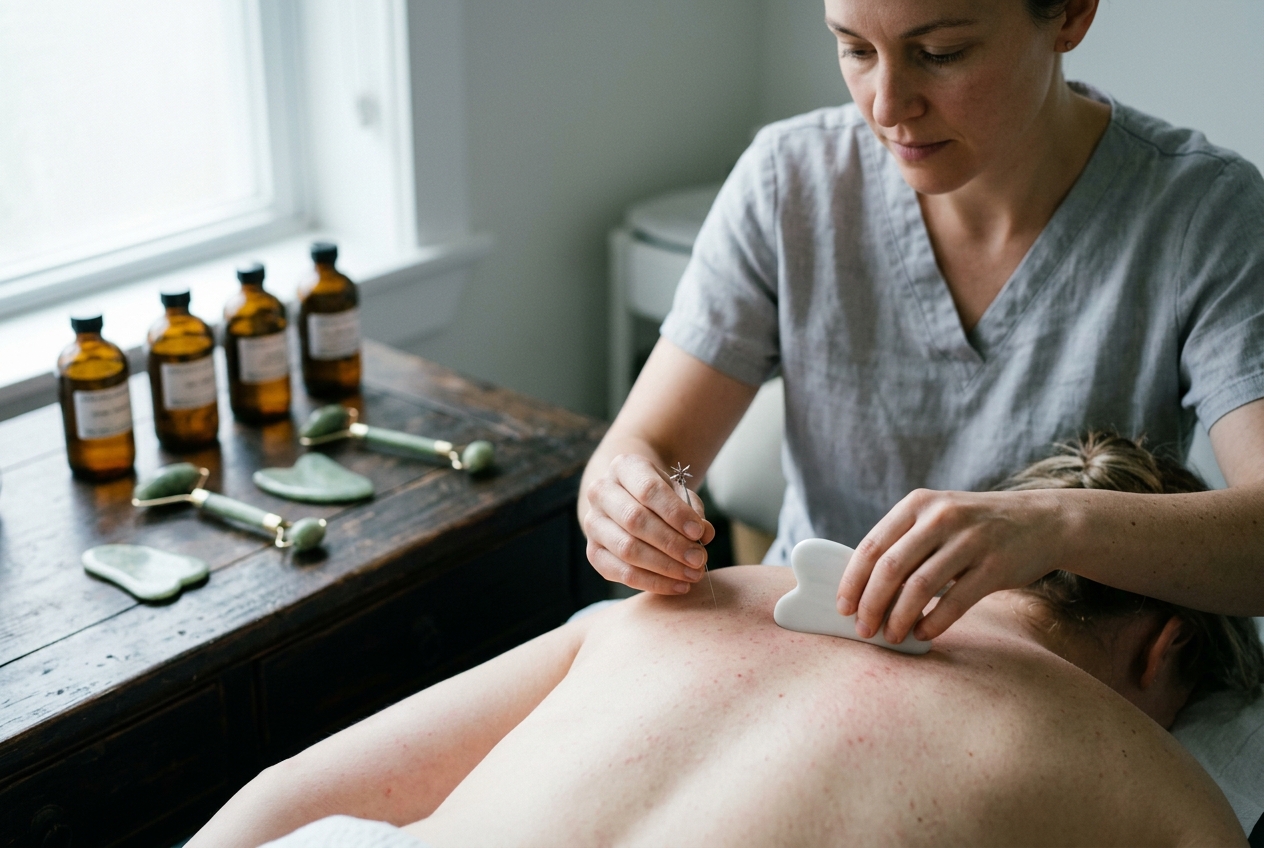
1. Opening Scene — A Moment You'll Recognise
You step out of an air-conditioned room into a sharp autumn draught, and within seconds, a sudden shiver races across the nape of your neck. The fine hairs on your forearms stand on end, your skin blenches momentarily, and a subtle tightness settles across your upper back and shoulders. Hours later, you feel the first inkling of a scratchy throat or an inexplicable wave of lethargy.
Most of us dismiss this phenomenon as a fleeting somatic quirk—a simple muscular spasm or a reflexive burst of piloerection. Yet in the classical framework of Traditional Chinese Medicine (TCM), this immediate, surface-level reaction is nothing less than the opening skirmish in a sophisticated physiological defence system.
Long before an environmental pathogen, viral particle, or climatic stressor breaches your mucous membranes or internal biochemistry, it encounters the outermost frontier of human anatomy: your skin. Far from being an inert protective wrap, your cutaneous envelope is an active, highly communicative sensory and immunological organ. Classical medical theory mapped this dynamic surface into twelve distinct territorial zones known as the Twelve Cutaneous Regions (Pi Bu, 皮部).
When you feel that draft, you are not merely experiencing temperature change; your nervous system, fascial fabric, and superficial microcirculation are coordinating an immediate immunological defence across these precise cutaneous zones. Understanding this living shield transforms how we interpret everyday physical sensations—from sudden cold patches on our thighs to unexplained skin sensitivities—revealing how our outer surface constantly dialogues with our deepest internal organs.
2. What This Organ System Does
The Architecture of the Cutaneous Boundary (Pi Bu)
In traditional meridian theory, the body's energetic and vascular infrastructure is structured in progressive architectural depths. As articulated in Chapter 56 of the foundational medical canon, the Huangdi Neijing Suwen ("Treatise on the Cutaneous Regions"), the body does not simply possess twelve primary channels (Jing Mai); it projects those channels outward onto the skin's surface.
The Twelve Cutaneous Regions (Pi Bu) represent the superficial broad zones of skin that correspond directly to the pathways of the twelve primary meridians and their associated internal organs (Zang-Fu). While primary meridians are conceptualized as linear conduits coursing through deep muscular planes and fascial compartments, the Pi Bu are expansive, continuous two-dimensional territories—analogous to dermatomes in modern neurology.
These cutaneous fields are governed predominantly by the Lung (Fei), which in classical physiology oversees the skin, the opening and closing of sweat pores (Xuan Fu, 腠理), and the dispersal of Defensive Qi (Wei Qi). Wei Qi is a fast-moving, warming, and protective bio-energetic resource circulating within the subcutaneous fascia and dermal layers. When environmental stressors—traditionally termed the Six Evils (Liu Yin), including Wind (Feng), Cold (Han), Dampness (Shi), and Heat (Re)—confront the human frame, the Pi Bu serves as the first line of immunological and thermoregulatory resistance.
| Meridian Cutaneous Division | Chinese Designation | Primary Organ Association | Modern Dermatomal & Anatomical Correlate |
|---|---|---|---|
| Taiyin Cutaneous Region | 手/足太陰皮部 | Lung (Fei) & Spleen (Pi) | Anterolateral arm (C5–T1), Medial aspect of lower limb (L4–S1) |
| Shaoyin Cutaneous Region | 手/足少陰皮部 | Heart (Xin) & Kidney (Shen) | Medial arm/axilla (C8–T1), Plantar surface & postero-medial leg (L5–S2) |
| Jueyin Cutaneous Region | 手/足厥陰皮部 | Pericardium (Xin Bao) & Liver (Gan) | Mid-anterior forearm (C6–C7), Medial thigh & groin (L2–L4) |
| Taiyang Cutaneous Region | 手/足太陽皮部 | Small Intestine (Xiao Chang) & Bladder (Pang Guang) | Posterior arm/scapula (C8–T2), Entire dorsal paraspinal column & posterior leg (S1–S2) |
| Shaoyang Cutaneous Region | 手/足少陽皮部 | San Jiao (Triple Burner) & Gallbladder (Dan) | Lateral aspect of arm/shoulder (C5–C7), Lateral torso, flank, and lateral leg (L4–S1) |
| Yangming Cutaneous Region | 手/足陽明皮部 | Large Intestine (Da Chang) & Stomach (Wei) | Anterolateral forearm/index finger (C6–C7), Anterior thigh, shin, and dorsum of foot (L2–L5) |
Modern Biomechanical, Fascial, and Neurovascular Parallels
Modern research evaluated by the World Health Organization (WHO) and published in peer-reviewed biomedical literature indicates that the Twelve Cutaneous Regions align remarkably with established physiological structures:
- Dermatomes and Somatosensory Innervation: Each Pi Bu mirrors the cutaneous sensory distribution supplied by specific spinal nerve roots. Sensory stimulation applied to a cutaneous zone sends afferent signals via low-threshold A-beta and unmyelinated C-tactile fibres into the dorsal horn of the spinal cord, modulating autonomic activity.
- The Interstitial Fascial Web: As evidenced by contemporary histological studies on fascial mechanotransduction, the subcutaneous superficial fascia is an uninterrupted liquid-crystal matrix of collagen and elastin fibers embedded in a glycosaminoglycan gel. Mechanical tension or cutaneous shear stress travels continuously across this web, converting physical pressure into intracellular chemical cascades via integrin receptors.
- Somato-Visceral Reflex Arcs: Neurophysiological research indexed in NCBI PubMed confirms that stimulating peripheral dermatomal receptors triggers somato-visceral neural reflexes. Mechanoreceptors (such as Merkel discs and Ruffini endings) synapse with sympathetic and parasympathetic preganglionic neurons, directly altering visceral blood perfusion, gastrointestinal motility, and neuroendocrine output.
- Microcirculatory Endothelial Activation: Cutaneous stimulation directly upregulates endothelial nitric oxide synthase (eNOS) and calcitonin gene-related peptide (CGRP). This induces local vasodilation, accelerates lymph drainage, and mobilizes macrophage activity within the superficial vascular plexuses (Sun Luo).
3. How You Can Feel It — Signs of Balance and Imbalance
Because the Pi Bu serves as a bi-directional interface—reflecting internal organ health outward while receiving external stimuli inward—the state of your skin provides immediate diagnostic clues regarding your systemic balance. When Wei Qi is abundant and the underlying organ networks are harmonious, the cutaneous tissue appears supple, uniform in color, smoothly responsive to temperature shifts, and resilient under light palpation.
When balance falters, subtle somatic and visual indicators emerge across specific cutaneous territories.
+-----------------------------------------------------------------------------------+
|               CUTANEOUS SURFACE DIAGNOSTIC MANIFESTATIONS                         |
+-----------------------------------------------------------------------------------+
| 1. ERYTHEMA & LOCAL HEAT          --> Heat/Inflammation in corresponding Zang-Fu  |
| 2. PALLOR & CUTANEOUS COLDNESS     --> Qi/Yang Deficiency or External Cold Stasis  |
| 3. PURPLE/CYANOTIC SPIDER VENULES --> Blood Stasis (Xue Yu) in Collateral Plexus  |
| 4. FASCIAL ROPINESS & INDURATION   --> Chronic Channel Obstruction & Stagnation   |
| 5. CUTANEOUS PARESTHESIA/NUMBNESS --> Wei Qi Depletion & Sensitization Failure    |
+-----------------------------------------------------------------------------------+
Key Diagnostic Indicators Across the Cutaneous Field
- Tissue Discoloration (Se, 色):
- Unusual Pallor or Blanching: Indicates a local deficiency of Wei Qi and microvascular hypoperfusion, leaving the region susceptible to external cold.
- Persistent Redness or Heat (Erythema): Indicates exuberant pathogenic heat or inflammatory cytokine upregulation associated with the corresponding internal organ (e.g., redness along the malar region and upper chest reflecting Lung and Heart heat).
- Sallow, Dull Yellowing: Reflects Spleen Qi deficiency and impaired fluid metabolism affecting dermal hydration.
- Cyanotic or Darkening Tones: Suggests microvascular blood stasis (Xue Yu) and sluggish venous return.
- Superficial Spider Venules (Xue Luo, 血絡):
- The emergence of tiny, superficial telangiectasias or fine, purplish-blue spider venules on specific body zones (such as behind the knees in the Taiyang region or along the medial ankle in the Shaoyin region) signals chronic blood stagnation and localized fascial congestion.
- Tactile Temperature Differentials:
- Run the back of your hand along your skin. Finding patches that feel icy cold compared to surrounding tissue indicates localized collapse of Wei Qi thermoregulation, often accompanied by underlying visceral sluggishness.
- Tissue Elasticity and Fascial Ropiness (Turgor & Induration):
- Healthy skin rebounds instantly upon light pinching. A loss of viscoelastic recoil, a "doughy" texture, or the presence of tender subcutaneous nodules ("pea-sized grains" or string-like myofascial taut bands) indicates prolonged energetic and fluid stagnation in that channel's cutaneous territory.
================================================================================
              SELF-ASSESSMENT: MAPPING YOUR CUTANEOUS BARRIER
================================================================================
Take 2 minutes to perform this gentle physical inventory:

1. THE TEMPERATURE SWEEP:
   Gently pass the dorsum (back) of your hand down your upper back, your
   lateral arms, and your anterior thighs. Are there distinct cold zones?
   -> Cold across the upper back indicates Taiyang/Lung Wei Qi vulnerability.

2. THE VISCOELASTIC PINCH:
   Lightly lift the skin along the webbing between your thumb and index
   finger, and over your anterior shin. Does the skin feel supple and elastic,
   or rigid, sensitive, and dry?
   -> Tenderness and stiffness indicate stagnation in the Yangming zone.

3. THE TEXTURE & DERMATOGRAPHIA CHECK:
   Draw a fingernail lightly along your inner forearm (Taiyin/Jueyin zone).
   Does it leave a persistent, raised white streak (cold/deficiency) or an
   immediate, angry red flare (latent heat)?
================================================================================
4. Qigong & Movement Practice: Cutaneous Patting and Channel Resonance (Pai Da Gong)
To invigorate the Twelve Cutaneous Regions, optimize Wei Qi circulation, and facilitate fascial mechanotransduction throughout the superficial dermal layers, classical health preservation traditions (Yang Sheng) utilize Pai Da Gong (Rhythmic Cutaneous Patting Qigong). This accessible, equipment-free somatic practice stimulates mechanoreceptors, releases nitric oxide into microvascular beds, and reinforces the body's defensive boundary.
Step-by-Step Practice Guide
1. Starting Position and Structural Alignment
- Stand with your feet shoulder-width apart, knees softly unlocked (micro-bent).
- Allow your tailbone to sink naturally toward the floor, lengthening your lumbar spine.
- Relax your shoulders down away from your ears, suspend your crown gently as if drawn up by a silk thread, and rest the tip of your tongue lightly on the upper palate behind your front teeth.
- Shape your hands into "Hollow Palms" (Xu Zhang): lightly cup your palms so that when you pat the body, a pocket of air is trapped against the skin, producing a soft, hollow popping sound rather than a sharp, stinging slap.
2. Breath Timing and Movement Sequence
- The Yangming & Taiyin Arm Circuit (Upper Limb Defense):
- Extend your left arm forward at chest height, palm facing upward.
- Inhale deeply through your nose into your lower abdomen (Dan Tian).
- On a steady, unforced exhalation, use your right cupped palm to lightly pat down the inner surface of your left arm—from the shoulder, over the biceps, through the inner elbow, down the wrist to the palm (traversing the Lung/Taiyin cutaneous field).
- Turn your left hand over so the palm faces downward. Inhale smoothly, and on your exhalation, pat up the outer surface—from the back of the hand, up the outer forearm, elbow, and shoulder (traversing the Large Intestine/Yangming cutaneous field).
-
Repetitions: Complete 6 full continuous cycles on the left arm, then switch and perform 6 cycles on your right arm.
-
The Dorsal Taiyang & Paraspinal Circuit (Back & Spine Boundary):
- Place both cupped hands behind your lower back over your kidneys.
- Inhale, expanding your lower back.
- On the exhale, rhythmically pat downwards across your sacrum, gluteals, and down the backs of your thighs, calves, and ankles (stimulating the Bladder/Taiyang cutaneous zone).
- Inhale as you return to an upright posture, resting your hands over your lower abdomen.
- Repetitions: Complete 9 downward rhythmic sweeps.
                       ========================================
                            PHYSICAL SENSATIONS TO OBSERVE
                       ========================================
                       • A warm, tingling sensation across the skin ("De Qi" & microcirculatory flush)
                       • A feeling of lightness and surface expansiveness
                       • Spontaneous deep exhalations or sighs (Autonomic nervous reset)
- Practice Duration: 5 to 8 minutes daily, ideally performed in the morning or prior to outdoor exposure.
5. Acupressure Points You Can Try Today
Acupressure points act as high-density neurovascular nodes embedded within their respective cutaneous zones. Applying steady mechanical pressure stimulates local nerve endings, triggers endorphin release, and balances the autonomic nervous system via somato-visceral pathways detailed in modern neuro-acupuncture research.
1. Lieque (LU-7, "Broken Sequence") — Lung Channel / Taiyin Region
- Anatomical Location: Interlock the webs of your thumbs and index fingers of both hands. The index finger of your upper hand will rest naturally along the styloid process of your opposite radial bone. Feel for a distinct notch or slight groove just above the wrist crease on the thumb side.
- Application Technique:
- Apply firm, steady pressure using the tip of your thumb, angling the pressure slightly upward toward the elbow.
- Maintain steady compression combined with small, circular micro-rotations for 1 to 2 minutes per side.
- Keep the pressure firm enough to produce a distinct, dull ache or spreading warmth (De Qi sensation) without sharp discomfort.
- Everyday Utility: The primary classical point for releasing the exterior and treating ailments of the head and neck. Ideal for the onset of a draft-induced stiff neck, early viral scratchiness in the throat, frontal headaches, and seasonal allergic reactivity.
2. Hegu (LI-4, "Joining Valley") — Large Intestine Channel / Yangming Region
- Anatomical Location: On the dorsum of the hand, located in the fleshy mound between the first (thumb) and second (index finger) metacarpal bones. Bring your thumb and index finger tightly together; a small muscle ridge will rise. Place your opposite thumb on the peak of that ridge, then relax your hand.
- Application Technique:
- Direct your thumb pressure not straight down, but angled toward the bone of the second metacarpal (index finger).
- Use deep, sustained, pulsing pressure for 2 to 3 minutes.
- Note: Contraindicated during pregnancy due to its downward-draining action.
- Everyday Utility: Widely researched for its analgesic and immunomodulatory properties. Highly effective for tension headaches, sinus congestion, toothaches, facial tension, digestive sluggishness, and general stress reduction.
3. Fengmen (BL-12, "Wind Gate") & Feishu (BL-13, "Lung Shu") — Bladder Channel / Taiyang Region
- Anatomical Location: Located on the upper back. Find the prominent bony protrusion at the base of your neck (the 7th cervical vertebra, C7). Move down two vertebrae to the second thoracic vertebra (T2). Fengmen (BL-12) lies roughly two finger-widths lateral to the lower border of the spinous process of T2. Feishu (BL-13) sits directly beneath it, adjacent to T3.
- Application Technique:
- If self-administering, place a firm tennis ball or massage ball between your upper back and a smooth wall.
- Lean back gently, adjusting your stance so the ball presses into the muscular channel between your spine and your shoulder blade.
- Breathe slowly and deeply, letting your body weight apply steady pressure for 2 minutes, gently shifting slightly up and down.
- Everyday Utility: The primary defensive gateways of classical medicine. Activating this cutaneous zone dissipates trapped environmental cold, eases upper back and shoulder tightness, relieves asthma or tight chest breathing, and bolsters systemic immunity against seasonal illness.
6. Food & Lifestyle — Small Changes for Today
Supporting your Twelve Cutaneous Regions and maintaining an adaptable Wei Qi barrier does not require exotic herbal preparations. Simple, targeted adjustments to your daily culinary choices and somatic habits provide the building blocks necessary for robust dermal health and environmental resilience.
+-----------------------------------------------------------------------------------+
|                        SEASONAL LIFESTYLE & DIETARY MATRIX                        |
+-----------------------------------------------------------------------------------+
|  BENEFICIAL ADDITIONS (Dispersing & Moistening)   |  REDUCE / MINIMIZE (Damp & Depleting) |
+---------------------------------------------------+---------------------------------------+
|  • Pungent aromatics (Fresh ginger, scallions)    |  • Iced drinks & frozen food items    |
|  • White hydrating vegetables (Daikon, pear, leek)|  • Excessive refined dairy & sugars   |
|  • Healthy fats (Omega-3s, olive oil, walnuts)    |  • Direct cold drafts on sweaty skin  |
|  • Warm bone/vegetable broths                     |  • Prolonged sedentary skin exposure  |
+-----------------------------------------------------------------------------------+
1. Dietary Adjustments for the Cutaneous Matrix
In classical dietary therapy, foods with a mildly pungent flavor possess a dynamic outward-moving energy that diffuses Qi to the body's surface, while moistening foods ensure the subcutaneous fascia remains hydrated.
- What to Add:
- Fresh Ginger (Sheng Jiang) & Scallions: Gently warming and diaphoretic. Adding thin slices of fresh ginger and chopped green onions to morning broths or teas encourages peripheral capillary circulation and reinforces Wei Qi without overheating the body.
- Pears (Li) and Stewed Apples: The Lung governs both the skin and fluid dispersal. Stewed pears (optionally poached with a small pinch of cinnamon) deeply hydrate the skin and soothe dry respiratory pathways, countering dry, cracked cutaneous tissues.
- Daikon Radish and White Root Vegetables: White foods are classically linked to the Lung-Skin axis. Daikon radish aids digestion, clears phlegm, and keeps metabolic pathways clear so defensive energy reaches the periphery.
-
High-Quality Lipids: Incorporating extra-virgin olive oil, avocados, flaxseeds, and walnuts ensures flexible lipid bilayers in dermal cells and healthy fascial glide.
-
What to Reduce:
- Excessive Raw, Iced, and Refrigerated Items: Consuming iced beverages or large quantities of cold, uncooked salads weakens the digestive fire (Pi Yang). This creates internal dampness and deprives the skin of the bio-energetic fuel needed to sustain a strong thermoregulatory barrier.
- Refined Sugars and Heavy Dairy: Promote systemic inflammatory cascades and cutaneous congestion, manifesting as acne, eczema, or sluggish cutaneous lymphatic drainage.
                       ========================================
                          THE MORNING DEFENSIVE TONIC RECIPE
                       ========================================
                       • 3-4 thin slices of fresh ginger root
                       • 1 white scallion bulb (lightly bruised)
                       • 1 slice of fresh lemon or small slice of pear
                       • 300ml simmering water (steep covered for 7 mins)

                       Drink warm upon waking to clear your respiratory
                       passages and warm your outer cutaneous boundary.
2. Environmental and Somatic Lifestyle Habits
- Protect the "Wind Triangle": The nape of the neck and upper thoracic spine (Feng Chi, Feng Fu, and Fengmen) are particularly susceptible to climatic invasion. When commuting, cycling, or working in air-conditioned environments, wear a lightweight scarf or high collar to protect this vulnerable cutaneous entry point from drafts.
- Warm Cutaneous Friction (Gan Xi): After your morning shower, use a dry, coarse cotton towel to vigorously rub your skin—starting from your extremities and moving toward your heart—for 60 seconds. This friction stimulates superficial nerve endings, encourages lymphatic flow, and activates peripheral microcirculation.
- Hydration with Electrolyte Balance: Dehydrated fascia loses its piezoelectric and mechanosensory properties. Sip warm water or mild herbal teas throughout the day rather than gulping cold water, ensuring steady interstitial fluid levels across all dermal layers.
7. Today's Takeaway
If you do only one thing today for your cutaneous health and systemic resilience, spend five minutes this evening doing a warm towel friction rub across your neck, shoulders, and arms, followed by ninety seconds of firm circular pressure on Lieque (LU-7). This simple, zero-cost ritual clears surface tension, stimulates your microcirculation, and resets the sensory boundary between your internal organs and the external world.
Authoritative References & Further Academic Reading
- World Health Organization. (2020). WHO Traditional Medicine Strategy: 2014-2023 & Guidelines for Standardized Terminology. WHO Health Topics
- Langevin, H. M., et al. (2012). Mechanotransduction in the subcutaneous connective tissue and its role in integrative acupuncture therapy. NCBI PubMed / J Clin Med
- Unschuld, P. U. (2011). Huang Di Nei Jing Su Wen: Nature, Knowledge, Imagery in an Ancient Chinese Medical Text. Wikipedia: Traditional Chinese Medicine Meridian Theory
- Takahashi, T. (2014). Mechanism of acupuncture on neuromodulation and somato-visceral reflexes. NCBI PubMed / Evid Based Complement Alternat Med
- National Center for Complementary and Integrative Health (NCCIH). (2023). Acupuncture and Cutaneous Somatosensory Stimulation: Modern Biological Mechanisms. NCBI PubMed Clinical Overviews