Quantum Zeno Effect: Suppressing Unitary Evolution and Protecting Coherence Via High-Frequency Projective Measurements
1. Opening Hook — Why You Should Care
Every computer you have ever touched, from the silicon chip inside your wristwatch to the supercomputers orchestrating global financial networks, operates on a simple, comforting assumption: reading information does not fundamentally change what is being read. A digital file sitting on a hard drive does not alter its contents when opened, and an electric current passing through a transistor does not freeze in its tracks simply because a sensor measures its voltage.
In the subatomic world, this classical intuition completely breaks down.
The greatest technological race of the twenty-first century—the quest to construct fault-tolerant quantum computers capable of simulating complex life-saving molecules, cracking foundational cryptographic algorithms, and optimizing global logistics—is currently locked in an existential battle against decay. A quantum bit, or qubit, does not politely maintain its delicate calculations when exposed to the thermal jitter and electromagnetic noise of the everyday world. Left to itself for even a fraction of a millisecond, a qubit degrades, shedding its computational power into environmental chaos through a process known as decoherence.
Yet physicists have uncovered an astonishing countermeasure drawn directly from the strangest foundations of quantum mechanics: if you observe an unstable quantum state rapidly and repeatedly enough, it will never change. You can freeze an atom in mid-transformation, halt radioactive decay, and lock fragile computational states in place purely through the act of measurement. Known as the Quantum Zeno Effect, this phenomenon is no longer an eccentric philosophical thought experiment. It has evolved into a practical engineering technique that helps protect quantum processors from errors and enables novel methods of controlling matter at the atomic frontier.
2. The Idea in Plain English
To understand how observation can freeze reality, we must first revisit a famous puzzle from ancient Greece. In the fifth century BCE, the philosopher Zeno of Elea proposed a series of paradoxes to demonstrate that motion is an illusion. In his arrow paradox, Zeno argued that at any single, indivisible instant of time, an arrow flying through the air occupies a space exactly equal to its own dimensions. Because it occupies a fixed space, it cannot be moving during that instant. If time is composed entirely of such frozen instants, Zeno concluded, the arrow can never actually move at all.
Classical physics easily resolved Zeno’s paradox through calculus and continuous motion: an object possesses instantaneous velocity at every point along its trajectory. But when twentieth-century physicists turned their attention to the subatomic world, they discovered that Zeno’s intuition was startlingly relevant to quantum systems.
Imagine a coin sitting on a table. In classical physics, the coin is either showing heads or tails. If you nudge the coin, it flips smoothly over. In the quantum realm, however, a system is governed by a wave of possibilities—a mathematical description that allows it to exist in a simultaneous mixture, or superposition, of both states. You can visualize this not as a coin resting flat on a table, but as a coin spinning smoothly on its edge. While it spins, it is neither purely heads nor purely tails.
Here is the crucial distinction: you cannot observe a quantum coin while it is spinning without forcing it to choose. The moment an external measurement occurs, the wave of possibilities collapses instantly into a definite reality—either 100% heads or 100% tails.
Now, suppose our quantum coin starts cleanly on heads, and natural atomic forces begin to tilt it toward tails. Crucially, quantum transitions do not happen in an instantaneous leap; they begin as an infinitesimally slow drift. In the very first moments of the transition, the probability that the coin has flipped to tails is virtually zero, while the probability that it remains on heads is overwhelmingly close to 100%.
If you look at the coin during this tiny initial window, the measurement forces the system to choose its state. Because the odds are heavily stacked in favor of heads, the measurement almost always finds heads—and in doing so, it collapses the quantum wave, resetting the clock to zero. If you look again an instant later, the same reset occurs. By measuring the system continuously, you trap the coin in its initial state, preventing it from ever completing its journey toward tails.
The proverbial watched pot really does never boil—provided you watch it with sufficient speed and precision.
3. How It Actually Works — The Mechanics
To see why the Quantum Zeno Effect occurs, we must examine the difference between the standard long-term decay of an atom and its ultra-short-term behavior.
For nearly a century, physicists modeled the decay of excited atoms or unstable particles using an exponential law governed by Fermi's golden rule. This rule predicts that an unstable system decays at a constant rate, meaning that the probability of survival decreases smoothly over time along a downward exponential curve. If this exponential behavior held true at every timescale, measuring the system repeatedly would make no difference whatsoever: resetting an exponential curve at intermediate points yields the exact same total decay rate.
However, fundamental quantum mechanics—rooted in the time-dependent Schrödinger equation studied extensively in courses like MIT OpenCourseWare Quantum Physics—dictates that the exponential law is only an approximation valid at intermediate and long timescales. At extraordinarily short intervals, the transition probability does not start linearly; it starts quadratically.
If a quantum system begins in an initial state $|\psi(0)\rangle$ and evolves under a Hamiltonian energy operator $H$, the short-time survival probability $P(t)$—the likelihood of finding the system still in its original state after a tiny time step $t$—is given by:
$$P(t) \approx 1 - \frac{(\Delta H)^2}{\hbar^2} t^2$$
Here, $\Delta H$ represents the quantum energy uncertainty (the spread of energy eigenstates within the system), and $\hbar$ is the reduced Planck constant. The vital feature of this equation is the exponent: the time variable $t$ is squared ($t^2$).
Because $t$ is squared, the survival probability drops with zero initial slope. If $t$ is a tiny fraction—say, $0.01$ seconds—its square is vastly smaller: $0.0001$. During this brief initial period, known as the Zeno time regime, the system barely moves away from its initial state.
In 1977, physicists Baidyanath Misra and E. C. George Sudarshan published a landmark theoretical paper establishing what is now known as the Quantum Zeno effect. They asked a simple question: what happens if you divide a total evolution time $t$ into $N$ equal intervals of duration $\tau = t/N$, and perform an ideal projective measurement at every interval?
At each step, the system survives in its initial state with probability $P(t/N) \approx 1 - \frac{(\Delta H)^2}{\hbar^2} \left(\frac{t}{N}\right)^2$. Across all $N$ consecutive measurements, the total survival probability $P_N(t)$ becomes the product of these individual probabilities:
$$P_N(t) = \left[ 1 - \frac{(\Delta H)^2}{\hbar^2} \left(\frac{t}{N}\right)^2 \right]^N \approx 1 - \frac{(\Delta H)^2 t^2}{\hbar^2 N}$$
As the frequency of observation increases toward infinity ($N \to \infty$), the fraction containing $N$ in the denominator vanishes entirely:
$$\lim_{N \to \infty} P_N(t) = 1$$
In this mathematical limit, known as the Misra-Sudarshan limit, continuous observation completely suppresses the time evolution of the quantum system. The wave function is perpetually projected back onto its starting state, rendering dynamic change impossible.
THE DUAL REGIMES OF QUANTUM OBSERVATION
- The Quantum Zeno Effect (Inhibition): When measurements occur within the characteristic Zeno time ($\tau < \tau_Z$), the quadratic survival regime dominates. The measurement resets the system before significant decay occurs, suppressing transitions and freezing the state.
- The Anti-Zeno Effect (Acceleration): If the measurement interval is slightly longer than the Zeno window ($\tau > \tau_Z$), the measurement can project the system into an environment with a dense continuum of decay channels. This actively speeds up the decay rate beyond its natural, undisturbed pace.
This second regime—the Anti-Zeno Effect—serves as a reminder that observation is an active, physical interaction. When you measure a quantum system, you inevitably inject energy into it. If your measurement frequency matches the energy spectrum of the surrounding environment, that injected energy can accelerate decay rather than halting it, as demonstrated across multiple papers in Physical Review Letters.
4. Real-World Applications Today
Far from remaining a laboratory curiosity, the ability to control quantum states through measurement has become an essential pillar of contemporary quantum information science. Researchers across academic institutions and industrial technology firms are leveraging both Zeno and Anti-Zeno mechanisms to engineer robust quantum technologies.
1. Quantum Error Suppression in Superconducting Processors
In the development of large-scale quantum computers, platforms like IBM Quantum rely on superconducting transmons cooled to millikelvin temperatures. A primary challenge in these systems is preventing quantum information from leaking out of the designated computational subspace (the 0 and 1 states) into higher, unwanted energy levels (such as the 2 state).
By coupling the data qubit to an auxiliary "ancilla" resonator and reading out the ancilla at microsecond intervals, engineers perform non-destructive parity checks. This frequent measurement suppresses transitions out of the valid computational space through the Quantum Zeno Effect, pinning the quantum information securely inside its operational bounds without disturbing the underlying calculation.
2. Quantum Zeno Dynamics (QZD) and Subspace Engineering
Pioneered theoretically by Saverio Pascazio and confirmed experimentally in Nature Physics, Quantum Zeno Dynamics goes a step beyond freezing a single state. If measurements project a system not onto a single point, but onto a multidimensional subspace, the system is free to evolve dynamically within that designated subspace while being strictly prevented from leaving it.
Research teams at Yale University and the Collège de France have used QZD to sculpt complex multi-photon states inside microwave cavities. By setting up continuous measurement barriers, they create "quantum guard rails" that guide microwave photons into highly resilient cat states and binomial codes, creating self-correcting logical qubits for fault-tolerant computing.
3. Trapped-Ion Atomic Clocks and Quantum Metrology
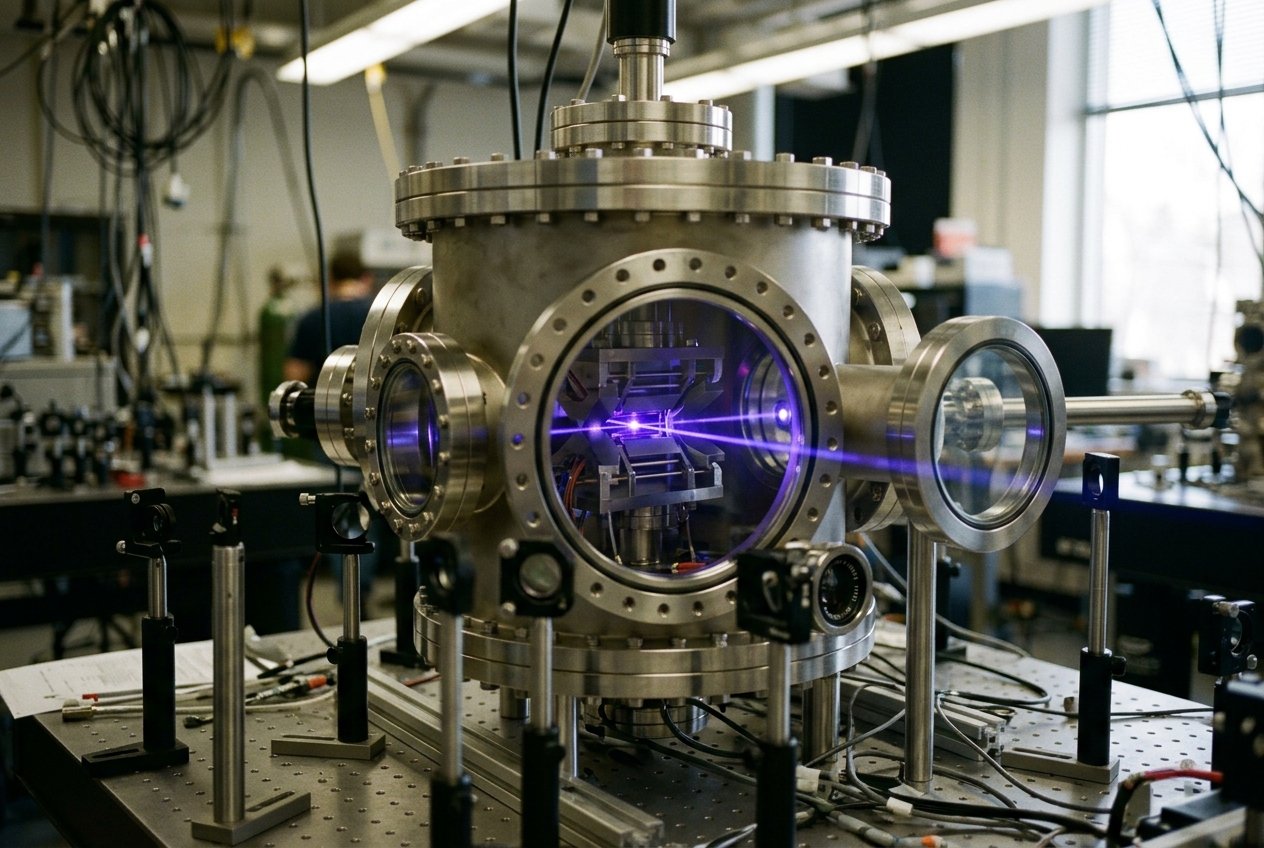
The earliest laboratory demonstration of the Quantum Zeno Effect was performed in 1990 by Wayne Itano and his colleagues at the National Institute of Standards and Technology (NIST), using a cloud of trapped $^9\text{Be}^+$ (beryllium) ions. By applying short optical laser pulses to interrogate the ions while driving a radio-frequency transition, they showed that increasing the measurement rate systematically suppressed transitions between energy levels.
Today, next-generation optical lattice clocks and trapped-ion quantum sensors use related Zeno techniques to suppress frequency shifts caused by stray environmental magnetic fields and thermal blackbody radiation. By rapidly interrogating auxiliary transition levels, these instruments achieve timing precision that would lose less than a single second over the age of the universe.
4. Quantum Biology and Photosynthetic Energy Transport
In biophysics, researchers investigating light-harvesting complexes have discovered that nature may exploit an environmental analogue of the Zeno effect. When sunlight strikes a plant's chlorophyll molecules, it creates an exciton (an energy packet) that must travel across a network of molecules to reach a reaction center with near-100% efficiency.
Calculations indicate that purely coherent quantum motion would get trapped in destructive interference loops, while purely classical hopping would be too slow. Instead, continuous environmental interactions—molecules jiggling and effectively "measuring" the exciton's location—strike a balance between the Zeno and Anti-Zeno regimes. This environmental monitoring suppresses destructive paths and funnels energy rapidly down the most efficient biological conduit.
5. What This Means for You
It is easy to view quantum mechanics as an abstract domain detached from everyday life, but the practical consequences of controlling measurement effects will define the next technological era.
Consider the development of pharmaceuticals. Designing a new drug currently takes over a decade and costs billions of dollars, largely because simulating how a complex protein folds or how a candidate molecule binds to a cellular receptor requires tracking billions of quantum mechanical interactions. Classical computers must rely on rough approximations. A fault-tolerant quantum computer could simulate molecular chemistry directly from fundamental physical laws, turning drug discovery from an empirical guessing game into a predictable engineering discipline.
The primary obstacle between today's noisy quantum prototypes and those transformative machines is decoherence—the exact process that the Quantum Zeno Effect helps counteract. When engineers use Quantum Zeno Dynamics to build protected logical qubits, they bring practical room-temperature superconductor discovery, optimized grid-scale energy storage, and targeted cancer therapies significantly closer to reality.
Furthermore, these principles reshape our fundamental understanding of privacy and security. Quantum key distribution networks, currently being deployed to protect sensitive government and financial infrastructure, rely on the fact that an eavesdropper cannot intercept a quantum signal without acting as an observer. The very act of intercepting and measuring the communication collapses the quantum states, alerting the communicating parties instantly to the intrusion.
6. Today's Takeaway
In the classical world, observing an object is an entirely passive act—light bounces off a surface, enters your eye, and leaves the object unchanged. In the quantum realm, observation is an active, physical intervention that continually forces nature to choose between competing possibilities. By measuring a quantum system rapidly within its initial quadratic window, we can halt its natural evolution, freezing atomic time in its tracks and turning one of quantum physics' strangest paradoxes into one of its most powerful engineering tools.