Quantum Walks: Harnessing Coherent Wave Traversal and Quantum Interference for Algorithmic Speedups
OPENING HOOK — WHY YOU SHOULD CARE
Imagine navigating the world's most intricate labyrinth. Every corridor splits into multiple directions, dead ends lurk behind every corner, and the path to the exit requires trillions of sequential, blind decisions. If you send a classical traveler through this maze, they must flip a coin at every junction, wandering back and forth, frequently retracing their steps, and spreading through the corridors with agonizing slowness. For centuries, this model—the classical random walk—has formed the computational backbone of everything from Google's original PageRank algorithm and Wall Street risk forecasting to logistics supply routing and molecular diffusion models.
Yet, this classical way of navigating complexity suffers from an inescapable mathematical curse: diffusion. Because a classical wanderer constantly stumbles backwards into visited spaces, the radius of territory explored expands only as the square root of the time invested. To search a network of a million nodes, a classical walker must wander for a million steps.
Enter the quantum walk.
Instead of choosing a single path at each intersection, a quantum particle exploits the counterintuitive laws of superposition and wave interference to explore all potential routes simultaneously. Waves that lead into dead ends cancel each other out through destructive interference, while waves propagating along open trajectories reinforce one another through constructive interference. Rather than diffusing like a slow drop of ink in water, a quantum walk surges forward like an unbroken tidal wave. This phenomenon—known as ballistic propagation—enables a quantum walker to cover distances quadratically, and in certain graph architectures exponentially, faster than any classical counterpart.
The consequences of this computational leap are profound. In the near future, the difference between diffusive and ballistic exploration will determine whether designing a life-saving pharmaceutical requires fifteen years of laboratory trial-and-error or four days of algorithmic simulation; whether urban power grids can instantly re-route electricity during cascading blackouts; and whether autonomous systems can search massive, unstructured datasets in seconds rather than millennia. Quantum walks are not merely a theoretical curiosity of modern physics; they represent an entirely new paradigm for how information moves through complex systems.
THE IDEA IN PLAIN ENGLISH
To build an intuition for quantum walks, we must first examine the archetypal thought experiment of classical probability: the Galton board, often called the "drunkard's walk."
Imagine a vertical wooden board covered in a staggered grid of pegs. A ball is dropped from the top. Every time the ball strikes a peg, it bounces either to the left or to the right with equal probability. As thousands of balls bounce down through the rows of pegs, they accumulate at the bottom into a familiar bell-shaped Gaussian distribution: the vast majority of balls end up clumped directly underneath the starting point, while only an infinitesimally small fraction manage to make a long string of consecutive leftward or rightward bounces to reach the far edges.
CLASSICAL RANDOM WALK (Diffusive Clumping)
                      [ Start: Drop Ball ]
                              •
                             / \
                            •   •
                           / \ / \
                          •   •   •
                         / \ / \ / \
     [===]              [=========]              [===]
  Far Left               Center Peak            Far Right
(Extremely Rare)       (Heavy Clumping)      (Extremely Rare)
-------------------------------------------------------------
Spreading Rate: σ ∝ √t  (Variance grows linearly with time)
This clustering happens because classical probabilities are strictly positive numbers that simply add together. A path of "left-right" and a path of "right-left" both deposit the ball right back in the center, compounding the central density. The spread of the classical walk—measured by its variance—grows only linearly with time ($t$). To double your distance from the starting point, you must wait four times as long; to triple it, you must wait nine times as long.
Now, replace the solid wooden ball with a single photon, electron, or trapped ion. In the quantum realm, the particle does not bounce either left or right. Instead, its internal state acts as a quantum coin that exists in a coherent superposition of pointing both left and right simultaneously. As the quantum wave packet moves through the lattice, it splits at every junction.
Crucially, quantum states are described not by positive real probabilities, but by complex probability amplitudes, which possess both a magnitude and a phase (an angle). When two quantum paths converge on the same node, their amplitudes combine like physical waves on the surface of water:
- Destructive Interference: If the crest of one path meets the trough of another (they are out of phase), they cancel each other out entirely, dropping the probability of finding the particle at that location to zero.
- Constructive Interference: If two crests arrive in phase, they amplify one another, multiplying the probability of the particle appearing there.
QUANTUM WALK (Ballistic Wave Surge)
                      [ Start: Quantum State ]
                                |ψ⟩
                              /     \
                           |ψ_L⟩   |ψ_R⟩
                            /   X   \
                           (Phase Interference)
                          /   /   \   \
     [=======]               [---]               [=======]
     Left Peak            Center Void           Right Peak
(Ballistic Outflow)    (Destructive Cancel)  (Ballistic Outflow)
-------------------------------------------------------------
Spreading Rate: σ ∝ t   (Variance grows quadratically with time)
In a standard quantum walk on a line, the mathematics of the quantum coin creates destructive interference across the center of the lattice and constructive interference at the outer frontiers. Instead of a bell curve bunched in the middle, the probability distribution splits into two towering, razor-sharp peaks racing outward toward the edges at constant velocity. The distance traveled scales directly with time ($t$), meaning the variance grows as $t^2$. The walker does not drift—it surges ballistically.
HOW IT ACTUALLY WORKS — THE MECHANICS
Quantum walks are fundamentally categorized into two mathematical frameworks: Discrete-Time Quantum Walks (DTQW) and Continuous-Time Quantum Walks (CTQW). Both achieve ballistic acceleration, but they do so through distinct mathematical formalisms.
+---------------------------------------------------------------------------------------------------+
| THE QUANTUM WALK TAXONOMY                                                                         |
+---------------------------------------------------------------------------------------------------+
| 1. DISCRETE-TIME QUANTUM WALK (DTQW)                                                              |
|    - Operates in distinct, quantized time steps (t = 0, 1, 2, ...).                              |
|    - Requires an internal coin state (Hilbert space: H = H_coin ⊗ H_position).                    |
|    - Evolution governed by alternating coin tosses and conditional position shifts.              |
|                                                                                                   |
| 2. CONTINUOUS-TIME QUANTUM WALK (CTQW)                                                            |
|    - Operates continuously over time under the Schrödinger equation.                             |
|    - Eliminates the coin space; acts directly on graph vertices (H = H_position).                 |
|    - Evolution governed directly by the graph's Adjacency or Laplacian Hamiltonian matrix.       |
+---------------------------------------------------------------------------------------------------+
1. Discrete-Time Quantum Walks (DTQW)
In a discrete-time quantum walk, evolution proceeds in integer clock ticks. To dictate which direction the particle moves on a graph, the system requires an auxiliary quantum degree of freedom called the coin space ($\mathcal{H}{\text{coin}}$), which couples to the position space ($\mathcal{H}{\text{position}}$). The total state of the system lives in the tensor product Hilbert space:
$$\mathcal{H} = \mathcal{H}{\text{coin}} \otimes \mathcal{H}{\text{position}}$$
For a one-dimensional line where the walker can move left ($|0\rangle$) or right ($|1\rangle$), the coin space is two-dimensional. A single discrete step of the walk is generated by a composite unitary operator $\hat{U}$, formed by applying a coin operator $\hat{C}$ followed by a conditional spatial shift operator $\hat{S}$:
$$\hat{U} = \hat{S} \cdot (\hat{C} \otimes \hat{I})$$
The coin operator $\hat{C}$ acts on the coin qubit to create a balanced superposition. A ubiquitous choice is the Hadamard coin operator (often studied in MIT OpenCourseWare Quantum Physics Resources), which rotates the basis states into symmetric and anti-symmetric superpositions:
$$\hat{C}_{\text{Hadamard}} = \frac{1}{\sqrt{2}} \begin{pmatrix} 1 & 1 \ 1 & -1 \end{pmatrix}$$
For higher-dimensional graphs with node degree $d$, the standard coin is the Grover coin operator, which provides maximum unbiased diffusion across all connecting edges:
$$\hat{C}_{\text{Grover}} = \frac{2}{d}\hat{J}_d - \hat{I}_d$$
where $\hat{J}_d$ is the all-ones matrix and $\hat{I}_d$ is the identity matrix.
Once the coin is transformed, the conditional position shift operator $\hat{S}$ moves the walker along the graph according to the coin's state:
$$\hat{S} = \left(|0\rangle\langle 0| \otimes \sum_{x} |x-1\rangle\langle x|\right) + \left(|1\rangle\langle 1| \otimes \sum_{x} |x+1\rangle\langle x|\right)$$
When this unitary cycle is repeated for $t$ steps, the state vectors along overlapping trajectories interfere constructively at the wavefronts and destructively at the origin, yielding the characteristic two-horned ballistic profile.
2. Continuous-Time Quantum Walks (CTQW)
Pioneered in 1998 by Edward Farhi and Sam Gutmann at MIT, continuous-time quantum walks discard the coin space entirely. Instead, the walker exists purely on the set of graph vertices $V = {1, 2, \dots, N}$. The position Hilbert space is spanned directly by the basis states ${|v\rangle : v \in V}$.
The system evolves under the standard time-dependent Schrödinger equation, where the role of the physical Hamiltonian $\hat{H}$ is played directly by the structural connectivity of the graph—specifically, the graph's adjacency matrix $\hat{A}$ or its Laplacian matrix $\hat{L} = \hat{D} - \hat{A}$ (where $\hat{D}$ is the diagonal degree matrix).
The state of the walker at any continuous time $t$ is calculated via the unitary matrix exponential:
$$i \hbar \frac{d}{dt}|\psi(t)\rangle = \hat{H} |\psi(t)\rangle \quad \implies \quad |\psi(t)\rangle = \exp\left(-\frac{i}{\hbar}\hat{H}t\right)|\psi(0)\rangle$$
Because $\hat{H}$ is Hermitian, the continuous transformation preserves the total probability amplitude across the graph while allowing probability density to tunnel and propagate coherently across the network's topological bonds. Researchers can explore these dynamics hands-on through interactive notebooks available in the IBM Qiskit Documentation and Tutorials.
+---------------------------------------------------------------------------------------------------+
| CORE RESULT: BALLISTIC VS. DIFFUSIVE SPREADING DYNAMICS                                          |
+---------------------------------------------------------------------------------------------------+
| By evaluating the variance of the position operator over time, we reveal the fundamental         |
| quadratic speedup that separates quantum coherent walks from classical Markov chains:              |
|                                                                                                   |
|                       Var_quantum(t) ~ O(t^2)   vs.   Var_classical(t) ~ O(t)                     |
|                                                                                                   |
| A classical walker requires t = 1,000,000 steps to achieve a spatial displacement of 1,000 units.|
| A quantum walker achieves that identical 1,000-unit displacement in merely t = 1,000 steps.      |
+---------------------------------------------------------------------------------------------------+
3. Algorithmic Superpowers: From Search to Exponential Speedup
The fundamental acceleration of quantum walks serves as the computational engine for two of the most celebrated algorithmic breakthroughs in quantum information science:
A. Spatial Database Search on Grid Lattices
Consider a database of $N$ items arranged on a $d$-dimensional spatial lattice, where one specific item is "marked." A classical search algorithm traversing the physical connections of the grid requires $\mathcal{O}(N)$ steps to locate the marked node.
By superimposing a continuous-time or discrete-time quantum walk with a localized perturbation (an energy shift or phase flip at the marked node), the marked item acts as an attractive potential well. The quantum walk's wave function constructively accumulates at the target node, concentrating its probability mass with quadratic efficiency. On a two-dimensional grid, a quantum walk locates the marked item in $\mathcal{O}(\sqrt{N \log N})$ time; for dimensions $d \ge 3$, it achieves the optimal Grover-like bound of $\mathcal{O}(\sqrt{N})$.
B. The Glued-Trees Problem: Provable Exponential Separation
While spatial search demonstrates a quadratic speedup, the famous "Glued-Trees" problem—formulated by Andrew Childs, Richard Cleve, Enrico Deotto, Edward Farhi, Sam Gutmann, and Daniel Spielman—demonstrated that quantum walks can achieve a provable, exponential speedup over all possible classical algorithms.
The problem constructs a graph consisting of two balanced binary trees of depth $n$, containing $2^{n+1} - 2$ nodes each. The two trees are joined together ("glued") at their leaf nodes by a randomized cycle of interconnected edges.
THE GLUED-TREES GRAPH TOPOLOGY
   Tree 1 Root                                                   Tree 2 Root
      (ENTRANCE)                                                    (EXIT)
         (o)                                                         (o)
        /   \                                                       /   \
      (o)   (o)                   RANDOM GLUED                    (o)   (o)
      / \   / \                   LEAF CONNECTIONS                / \   / \
     o   o o   o                   [=== INTERIOR ===]            o   o o   o
    / \ / \ / \ / \               [=== SHUFFLE  ===]            / \ / \ / \ / \
   *   *   *   *   *   <=====>    [================]   <=====>  *   *   *   *   *
  [ Layer 0 ... n-1 ]                  [ Leaves ]              [ Layer n-1 ... 0 ]
The challenge is simple: start at the root node of Tree 1 (the ENTRANCE) and find the root node of Tree 2 (the EXIT). Crucially, the oracle only provides local adjacency information—it does not provide a global map.
- The Classical Failure: As a classical walker moves from the ENTRANCE toward the center, each step deeper doubles the number of available forward branches. Once the classical walker reaches the glued interior, it becomes hopelessly lost in an exponential maze of leaf connections. The probability of stumbling backward toward the ENTRANCE is vastly higher than finding the unique pathway to the EXIT. Any classical algorithm requires an exponential number of steps: $\mathcal{O}(2^{n/2})$.
- The Quantum Triumph: A continuous-time quantum walk exploits the structural symmetry of the graph. Because all nodes in a given vertical layer of the tree are permutation-symmetric with respect to the root, the multi-dimensional tree structure collapses into an effective one-dimensional linear chain of $2n+2$ column states. As the continuous wave propagates across these column states, destructive interference completely eliminates the sprawling lateral paths, while constructive interference guides the wave cleanly across the glued interior from the ENTRANCE to the EXIT in polynomial time: $\mathcal{O}(n)$.
This milestone proved definitively that quantum interference in graph topologies can unlock computational speedups that are fundamentally inaccessible to classical computation, as detailed in Wikipedia's comprehensive overview of Quantum Walks.
+---------------------------------------------------------------------------------------------------+
| SUMMARY OF SPEEDUP REGIMES                                                                        |
+---------------------------------------------------------------------------------------------------+
| PROBLEM TYPE             | CLASSICAL COMPLEXITY       | QUANTUM WALK COMPLEXITY | ADVANTAGE       |
+--------------------------+----------------------------+-------------------------+-----------------+
| Spatial Grid Search      | O(N)                       | O(√N)                   | Quadratic       |
| Glued-Trees Traversal    | O(2^(n/2))                 | O(n)                    | EXPONENTIAL     |
| Element Distinctness     | O(N)                       | O(N^(2/3))              | Polynomial      |
| Triangle Finding (Graphs)| O(N^2)                     | O(N^(1.3))              | Polynomial      |
+---------------------------------------------------------------------------------------------------+
4. Physical Implementations and the Threat of Decoherence
Translating theoretical quantum walks into laboratory hardware has spurred extraordinary experimental innovation across several physical platforms:
                  +------------------------------------------------+
                  | EXPERIMENTAL QUANTUM WALK PLATFORMS            |
                  +------------------------------------------------+
                                           |
         +---------------------------------+---------------------------------+
         |                                 |                                 |
         v                                 v                                 v
+-------------------+             +-------------------+             +-------------------+
| INTEGRATED        |             | TRAPPED-ION       |             | SUPERCONDUCTING   |
| PHOTONICS         |             | SYSTEMS           |             | TRANSMON CIRCUITS |
| Silica & LiNbO3   |             | Hyperfine levels  |             | Josephson-junction|
| Waveguide Arrays  |             | & Phonon modes    |             | Transmon lattices |
+-------------------+             +-------------------+             +-------------------+
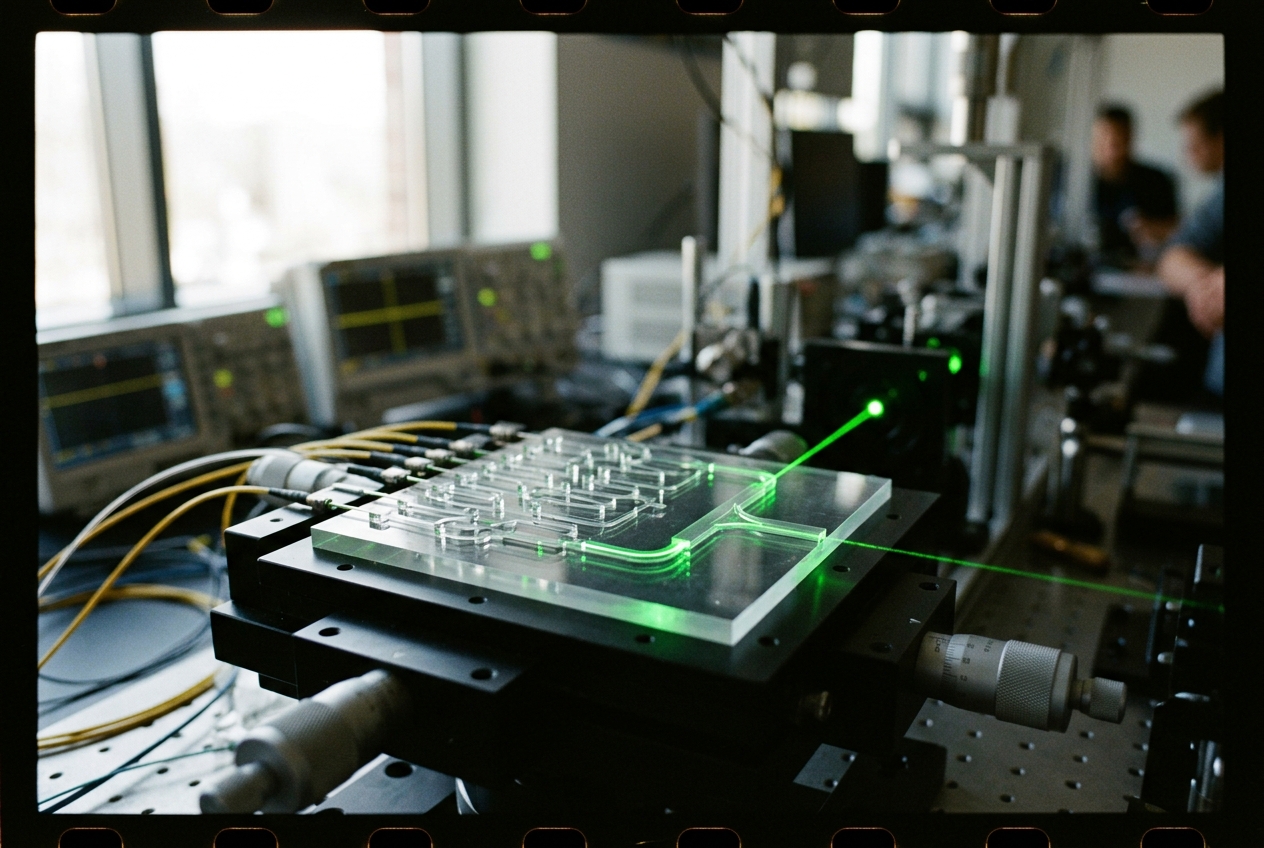
- Integrated Photonic Waveguide Meshes: Photons are routed through arrays of laser-etched waveguides on silica or thin-film lithium niobate chips. The spatial waveguide path encodes the position state, while evanescent directional couplers implement beam-splitter operations that act as the coin operator.
- Trapped-Ion Chains: Individual atomic ions (such as Ytterbium or Calcium) are held in electromagnetic traps. The internal hyperfine electronic states serve as the coin, while quantized vibrational motion (phonons) across the ion chain encodes the spatial position.
- Superconducting Quantum Processors: Planar arrays of transmon qubits coupled via resonant microwave cavities allow continuous-time quantum walks to be simulated by tuning inter-qubit capacitive coupling to represent arbitrary graph adjacency matrices.
However, all quantum walks face a deadly environmental adversary: decoherence.
If a stray thermal photon, magnetic fluctuation, or material defect interacts with the walker, it acts as an un-orchestrated quantum measurement. This interaction destroys the delicate phase relationships between competing trajectories. When relative phases are randomized, the destructive interference across the center evaporates, and the wave packet collapses into a localized classical state.
                                DECOHERENCE TRANSITION

  QUANTUM REGIME                                                  CLASSICAL REGIME
  (Coherent Phase Control)                                         (Phase Randomization / Noise)
  ======================                                          ============================
  • Wave-like propagation                                         • Particle-like diffusion
  • Ballistic Spread: σ ∝ t                                       • Diffusive Spread: σ ∝ √t
  • Destructive Cancellation                                      • Classical Probability Sums
  • Quadratic/Exponential Speedup                                 • Sluggish Exploration Clumping
As decoherence rates increase, the ballistic quantum walk undergoes a continuous phase transition back into a classical, diffusive Markov chain. Maintaining phase coherence across large spatial graphs remains the central engineering challenge of the field, an area of rigorous experimental study highlighted regularly in Physical Review Letters and the arXiv Quantum Physics Archive.
REAL-WORLD APPLICATIONS TODAY
Between 2024 and 2026, quantum walks transitioned from abstract mathematical curiosities into practical computational engines deployed across industrial research consortia:
1. Molecular Property Simulation and Drug Discovery
- Institutions: Quantinuum, Harvard University, and Boehringer Ingelheim.
- The Challenge: Designing pharmaceutical compounds requires modeling how electronic excitations (excitons) migrate through complex, three-dimensional molecular graphs. A prominent biological example is the Fenna-Matthews-Olson (FMO) photosynthetic light-harvesting complex, where nature uses near-lossless quantum coherent energy transfer to funnel solar energy to a reaction center.
- The Quantum Advantage: By mapping the Hamiltonian of a molecule directly onto a continuous-time quantum walk, researchers can simulate molecular energy transport and calculate chemical binding affinities in polynomial time. Classical supercomputers trying to track these multi-electron wave interactions face an exponential memory bottleneck.
2. Critical Infrastructure Resilience and Cyber-Vulnerability Detection
- Institutions: Fraunhofer Institute for Applied Information Technology, Cisco Quantum Labs, and the European Quantum Flagship.
- The Challenge: Modern power grids, telecommunication backbones, and financial transaction networks are vast graphs containing millions of interdependent nodes. Pinpointing single-point-of-failure "bridge nodes" or structural bottlenecks before bad actors exploit them is computationally intractable using standard graph centrality metrics like PageRank on ultra-large graphs.
- The Quantum Advantage: Continuous-time quantum walks propagate across network graphs, where topological bottlenecks naturally create reflected interference patterns. This enables the discovery of critical vulnerabilities, network clustering, and structural anomalies with polynomial-to-quadratic speedups over classical network analysis tools.
3. Graph Neural Networks and Machine Learning
- Institutions: MIT-IBM Watson AI Lab, Google Quantum AI, and Imperial College London.
- The Challenge: Classical Graph Neural Networks (GNNs) frequently suffer from "over-smoothing"—a mathematical failure where information from distant nodes washes out into an indistinct blur as the network gets deeper, blinding the AI to long-range graph patterns.
- The Quantum Advantage: Researchers are replacing classical message-passing layers with discrete-time quantum walk kernels. Because quantum walks preserve distinct phase signatures over vast topological distances without washing out, Quantum Walk Graph Neural Networks (QW-GNNs) achieve unprecedented accuracy in predicting toxicity in chemical compounds, classifying proteins, and analyzing high-dimensional social networks. Published works in Nature continually validate how quantum interference preserves structural information where classical diffusion fails.
WHAT THIS MEANS FOR YOU
For non-physicists, it is easy to view quantum mechanics as an exotic, isolated realm of microscopic quirks. But quantum walks transform those quirks into tangible real-world solutions:
- Next-Generation Therapeutics: You may soon take medications designed in months rather than decades. By replacing months of wet-lab synthesis with exact quantum walk simulations of how drug molecules navigate and bind to receptor proteins, biotechnology firms can eliminate dangerous side effects before clinical trials even begin.
- Blackout-Proof Power Grids: As extreme weather events strain aging electrical grids, quantum walk routing algorithms embedded within municipal energy hubs will autonomously balance loads and re-route power around damaged substations within milliseconds, preventing cascading blackouts.
- Uncompromised Logistics and Supply Chains: From shipping routes navigating global maritime disruptions to warehouse robotics fleets traversing sprawling fulfillment centers without gridlock, ballistic pathfinding algorithms ensure that the physical products you order arrive faster, cheaper, and with a significantly lower carbon footprint.
The core takeaway is simple: whenever humanity faces a problem defined by an overwhelming web of connections—whether those connections are atoms in a protein, servers on the internet, or transactions in the global economy—quantum walks provide the ultimate lens for navigating the labyrinth.
TODAY'S TAKEAWAY
A classical search is a blind stumble through the dark: flipping coins, retracing steps, and creeping outward with sluggish, diffusive slowness. A quantum walk is a coherent burst of light: exploring every corridor simultaneously, allowing destructive interference to extinguish false trails while constructive interference surges along the true path. By mastering the delicate art of quantum wave propagation, we are learning to navigate nature's most daunting labyrinths at the fundamental speed limit of the universe.