Quantum Threshold Theorem: Establishing Physical Error Limits for Scalable Fault-Tolerant Computation
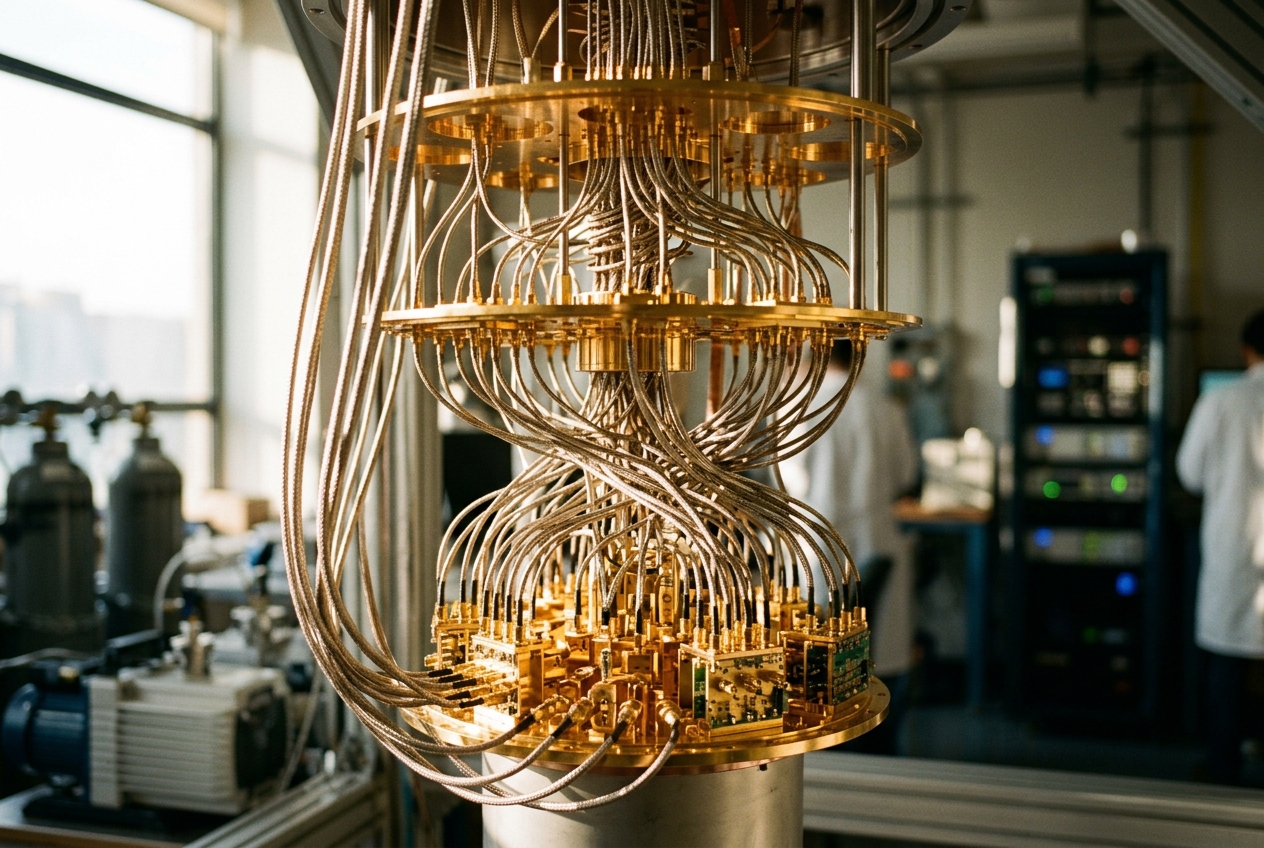
The digital infrastructure of modern civilization rests upon an invisible mathematical fortress. Every encrypted banking transaction, state secret, medical record, and secure communication channel relies on computational asymmetry: mathematical problems—such as factoring 2,048-bit integers or computing discrete logarithms on elliptic curves—that take classical supercomputers millennia to unravel, yet take mere fractions of a second to verify. A fully fault-tolerant quantum computer running Shor's algorithm could dismantle this cryptographic architecture in hours. Beyond cryptography, such machines possess the theoretical capability to simulate the quantum mechanics of molecular catalysts, unravel complex nitrogenase reaction pathways for synthetic fertilizers, and map the electronic properties of high-temperature superconductors.
Yet, for decades, a foundational physics paradox threatened to consign the entire field of quantum computing to theoretical fantasy. Quantum states are notoriously fragile. The slightest interaction with stray thermal photons, fluctuating magnetic fields, or microscopic material defects introduces decoherence, corrupting delicate superpositions into classical noise. In an analog computer, continuous accumulation of noise inevitably degrades long calculations beyond recovery. Early skeptics argued that quantum computers, which manipulate continuous probability amplitudes across complex Hilbert spaces, would suffer the exact same fate.
That skepticism was fundamentally disproved by the Quantum Threshold Theorem. This landmark mathematical principle proves that physical imperfection is not an insurmountable barrier to universal quantum computation. Provided that physical hardware operates with an error rate below a specific, mathematically defined critical threshold ($p < p_{\text{th}}$), quantum error-correcting codes can suppress logical noise exponentially faster than computational depth introduces it, at a poly-logarithmic cost in physical resources. Crossing this threshold represents the singular dividing line separating noisy, non-scalable prototype devices from fault-tolerant, utility-scale quantum supercomputing.
1. The Core Concept: Digitizing Fragility via Quantum Error Correction
To understand how the threshold theorem operates, one must first confront why correcting quantum information is profoundly more difficult than correcting classical bits. In classical computing, the foundational defense against noise is simple redundancy: to protect a bit value of $0$, a machine can store the triplicated string $000$. If a random environmental fluctuation flips one bit to produce $010$, a majority-voting logic gate inspects the bits, identifies the anomalous $1$, and restores the state to $000$.
Quantum mechanics, however, forbids this straightforward copying mechanism. The No-Cloning Theorem—proven by Wootters, Zurek, and Dieks in 1982—proves that it is mathematically impossible to create an identical, independent copy of an arbitrary unknown quantum state:
$$\alpha |0\rangle + \beta |1\rangle \not\to (\alpha |0\rangle + \beta |1\rangle) \otimes (\alpha |0\rangle + \beta |1\rangle)$$
Furthermore, any direct measurement of a quantum system collapses its superposition into a deterministic classical state, instantly destroying the very phase relationships that confer quantum speedup. Compounding the challenge, quantum noise is continuous rather than discrete: a qubit does not merely suffer from discrete bit-flips ($X$ errors, corresponding to Pauli $\sigma_x$), but also phase-flips ($Z$ errors, corresponding to Pauli $\sigma_z$), and arbitrary continuous rotations parameterized by infinitesimal angles $\theta$:
$$R(\theta) = \cos\left(\frac{\theta}{2}\right) I - i \sin\left(\frac{\theta}{2}\right) \vec{n} \cdot \vec{\sigma}$$
The breakthrough that unlocked quantum error correction was the discovery of error digitization through projective stabilizer measurements. Because the Pauli operators ${I, X, Y, Z}$ form a complete orthogonal basis for all linear operators on a single qubit, any arbitrary Kraus error operator $E$ acting on a state can be expressed as a linear combination of Pauli matrices:
$$E = c_0 I + c_1 X + c_2 Z + c_3 Y$$
When an encoded quantum state is subjected to an entangled syndrome measurement using auxiliary "ancilla" qubits, the quantum measurement does not measure the stored data directly. Instead, it measures multi-qubit parity operators—known as stabilizers—projecting the continuous error distribution into a discrete, identifiable Pauli operator without revealing or disturbing the logical superposition amplitudes $\alpha$ and $\beta$. Once the syndrome measurement identifies the discrete discrete syndrome, a classical decoding algorithm determines the most probable correction operator to invert the fault.
Authoritative documentation on stabilizer formalisms and quantum error correction principles is curated extensively through the MIT OpenCourseWare Quantum Information Science curriculum and the Wikipedia: Quantum Threshold Theorem archive.
2. The Mechanics of the Quantum Threshold Theorem
The Quantum Threshold Theorem (often termed the Fault-Tolerant Accuracy Threshold Theorem) was established in foundational papers between 1996 and 1998 by Dorit Aharonov and Michael Ben-Or, Alexei Kitaev, Emanuel Knill, Raymond Laflamme, Wojciech Zurek, and John Preskill.
The Formal Theorem Statement
The Quantum Threshold Theorem: Let a quantum circuit contain $N$ logical gates operating across a circuit depth $D$, requiring an overall target computational fidelity $1 - \epsilon$. There exists a strictly positive physical error threshold $p_{\text{th}} > 0$ such that, if the error probability per physical gate, state preparation, measurement, and idle step satisfies $p < p_{\text{th}}$, the quantum circuit can be simulated fault-tolerantly with arbitrary target accuracy $\epsilon$ using:
$$\text{Physical Qubit Overhead} = \mathcal{O}\left(N \cdot \text{polylog}\left(\frac{N}{\epsilon}\right)\right)$$ $$\text{Circuit Depth Overhead} = \mathcal{O}\left(D \cdot \text{polylog}\left(\frac{D}{\epsilon}\right)\right)$$
Before this theorem, it was widely conjectured that mitigating errors would require exponential resource overheads, because the gadgets designed to detect and correct errors are themselves composed of noisy physical components. If an error-correcting circuit introduces more noise than it removes, error correction accelerates computational collapse. The threshold theorem proves that below $p_{\text{th}}$, error correction cleanses entropy faster than the physical circuitry injects it.
Fault-Tolerant Gadgets and Error Containment
Fault tolerance requires that an error occurring anywhere within an error-correction gadget must not proliferate into an uncorrectable cascade of faults in the encoded logical data block. A gadget is defined as strictly fault-tolerant if it satisfies two rigorous criteria:
- A single physical fault occurring within the gadget produces at most one physical error in each output logical code block.
- If an input code block already contains $t$ physical errors and at most $s$ additional faults occur within the gadget (where $t + s \le \lfloor (d-1)/2 \rfloor$, with $d$ being the code distance), the output code block contains at most $t + s$ errors after correction.
To enforce these conditions, quantum engineers employ specialized architectural primitives:
- Transversal Logic Gates: A logical gate is transversal if it is applied as a tensor product of independent single-qubit operations acting strictly bitwise across corresponding physical qubits in separate code blocks ($U_L = \bigotimes_{i=1}^n U_i$). Because physical qubits within a code block never directly interact during a transversal gate, a fault in the $i$-th physical qubit cannot spread to the $j$-th qubit within the same block.
- The Eastin-Knill Theorem Limitation: Proven in 2009, the Eastin-Knill theorem dictates that no quantum error-correcting code can implement a universal set of logical gates purely through transversal operations. Universal quantum computation requires non-Clifford gates (such as the $T$-gate, $T = \text{diag}(1, e^{i\pi/4})$). Because transversal operations are restricted to the Clifford group, fault-tolerant architectures must inject non-Clifford gates via Magic State Distillation—a process wherein noisy auxiliary states are purified through stabilizer check routines before consumption in gate teleportation protocols.
- Fault-Tolerant Syndrome Extraction (Shor, Steane, and Knill Protocols): Measuring a multi-qubit parity check (e.g., $Z \otimes Z \otimes Z \otimes Z$) by coupling all four data qubits to a single ancilla qubit creates a vulnerability: a single bit-flip on the ancilla can propagate back via two-qubit entangling gates ($CNOT$) into multiple data errors. Shor extraction circumvents this by preparing entangled GHZ "cat states" for ancilla verification, while Steane extraction utilizes entire encoded logical auxiliary states, ensuring error propagation remains strictly transversal.
3. Concatenated Codes vs. Modern 2D Topological Surface Codes
The architecture of fault-tolerant systems has evolved across two primary structural paradigms: recursive hierarchical concatenation and topological surface codes.
Recursive Concatenation and Asymptotic Scaling
Early threshold proofs utilized concatenated quantum codes, such as the 7-qubit Steane code $[[7, 1, 3]]$ or the 9-qubit Shor code $[[9, 1, 3]]$. In a concatenated code, a single logical qubit is encoded into $n$ physical qubits at Level 1. Each of these $n$ physical qubits is then itself treated as a logical qubit and encoded into $n$ sub-qubits at Level 2, creating an $n^k$-qubit hierarchy at concatenation level $k$.
For a code correcting up to $t=1$ error (such as the $[[7, 1, 3]]$ code with minimum distance $d=3$), a logical failure at concatenation level $k$ occurs only if at least two independent errors occur in the same sub-block. The effective logical error probability $p_k$ obeys the recurrence relation:
$$p_k \le c \cdot p_{k-1}^2$$
where $c$ is a combinatoric factor representing the number of dangerous two-fault configurations within the fault-tolerant error correction circuit. Expanding this recurrence from the base physical error rate $p_0 = p$ yields:
$$p_k \le \frac{1}{c} (c \cdot p)^{2^k} = p_{\text{th}} \left( \frac{p}{p_{\text{th}}} \right)^{2^k}$$
where the critical threshold is precisely $p_{\text{th}} = 1/c$.
If $p < p_{\text{th}}$, the ratio $(p/p_{\text{th}}) < 1$, driving the logical error rate down doubly exponentially with respect to the concatenation level $k$. However, concatenated codes require long-range physical connectivity across expanding trees of qubits, making them challenging to implement on planar 2D microchips. The theoretical threshold for concatenated codes under realistic noise assumptions is relatively stringent, typically sitting between $p_{\text{th}} \approx 10^{-4}$ and $10^{-5}$ ($0.01\% - 0.001\%$).
Topological Surface Codes and Heavy-Hex Architectures
To overcome the requirement for non-local wiring, modern quantum engineering predominantly favors Topological Surface Codes, originally formulated by Alexei Kitaev in his 1997 Toric Code paper.
In a planar surface code, physical data qubits are arranged on the vertices and edges of a two-dimensional grid, interleaved with ancilla qubits that continuously monitor weight-4 stabilizer checks:
- Star Operators ($A_s$): Vertex checks measuring $X$-basis parity, $A_s = \bigotimes_{i \in \text{star}(s)} X_i$, detecting phase-flip ($Z$) errors.
- Plaquette Operators ($B_p$): Face checks measuring $Z$-basis parity, $B_p = \bigotimes_{j \in \text{boundary}(p)} Z_j$, detecting bit-flip ($X$) errors.
The logical information is encoded non-locally in the global topological degrees of freedom of the lattice. A logical error requires an unbroken chain of physical errors stretching completely across the lattice boundaries—a path of length equal to the code distance $d$.
The logical error probability $P_L$ for a surface code of distance $d$ scales as:
$$P_L \approx C \left( \frac{p}{p_{\text{th}}} \right)^{\frac{d+1}{2}}$$
Surface codes feature a remarkably high critical threshold: $p_{\text{th}} \approx 1.0\%$ under idealized phenomenological noise models, and approximately $p_{\text{th}} \approx 0.57\% - 0.70\%$ under full circuit-level depolarizing noise when decoded with algorithms like Minimum-Weight Perfect Matching (MWPM) or Union-Find decoders.
To mitigate parasitic frequency collisions and microwave crosstalk on superconducting chips, institutions like IBM have pioneered the heavy-hexagonal lattice architecture, which maps surface code stabilizer circuits onto sparse, degree-3 connectivity graphs, maintaining fault-tolerant thresholds while substantially reducing fabrication defect sensitivity. Detailed open-source implementations of these decoders and lattice mappings are accessible via IBM Quantum Qiskit.
4. Real-World Applications and Industrial Milestones (2024–2026)
The transition from theoretical fault tolerance to physical demonstration has accelerated dramatically. Between 2024 and 2026, leading quantum computing laboratories crossed the pivotal milestone of demonstrating that increasing code size suppresses logical error rates below physical error baselines.
1. Quantum Chemistry and Nitrogenase Catalyst Simulation (Google Quantum AI & BASF)
Industrial fertilizer synthesis via the Haber-Bosch process consumes roughly 1% to 2% of the entire global energy supply annually, operating at extreme temperatures and pressures. Nature achieves identical chemical reduction at ambient conditions using the active iron-molybdenum cofactor ($\text{FeMo-co}$) within the enzyme nitrogenase. Classical supercomputers cannot accurately compute the multireference electron correlation states of $\text{FeMo-co}$ due to exponential wave function scaling.
As reported in landmark publications in Nature, Google Quantum AI utilized its superconducting architecture to demonstrate that logical error suppression factors scale systematically with increasing code distance ($\Lambda = P_{L, d=3} / P_{L, d=5} > 1$). Operating fault-tolerant active spaces below the threshold will allow quantum phase estimation algorithms to resolve the catalytic mechanism of $\text{FeMo-co}$, unlocking paths toward low-energy ambient chemical synthesis.
2. High-Fidelity Entanglement Across Logical Memory (Quantinuum & Microsoft)
In the trapped-ion domain, Quantinuum, in collaboration with Microsoft, demonstrated fault-tolerant state preparation and syndrome extraction across barium and ytterbium ion chains shuttled through micro-fabricated RF surface traps. Utilizing high-fidelity two-qubit gates (exceeding physical fidelities of $99.9\%$), they demonstrated logical color codes where logical error rates were orders of magnitude lower than physical error baselines. This enables deep-circuit simulations for battery electrolyte materials and solid-state battery degradation interfaces.
3. Transversal Logical Gate Arrays in Neutral Atoms (Harvard, MIT, & QuEra Computing)
Neutral-atom architectures manipulate individual rubidium or cesium atoms suspended in two-dimensional optical tweezer arrays, entangling them by exciting atomic electrons to high-energy Rydberg states. In research published across Nature and physical review journals, a consortium comprising Harvard University, MIT, and QuEra Computing demonstrated dynamic shuttling of atomic arrays to execute transversal entangling gates across 48 dual-rail encoded logical qubits. Their architecture demonstrated error detection and zoned magic-state preparation, a crucial structural prerequisite for fault-tolerant optimization in complex logistics and materials design.
Comprehensive technical breakdowns of these architectures and their operational parameters are available through Nature Physics and the arXiv Quantum Physics Archive.
5. Hardware Overheads and Practical Implications
While the threshold theorem guarantees that scaling is asymptotically polynomial ($\mathcal{O}(\text{polylog}(N/\epsilon))$), the concrete constant factors required for physical implementations represent an extraordinary engineering undertaking.
To break a 2,048-bit RSA key using Shor's algorithm, a quantum system requires approximately 4,096 logical qubits executing roughly $10^9$ logical non-Clifford operations. If physical hardware operates at a physical gate error rate of $p = 10^{-3}$ ($0.1\%$, safely below the surface code threshold of $p_{\text{th}} \approx 0.7\%$), the system requires a code distance of $d \approx 27$. Under standard planar surface code configurations ($N_{\text{phys}} = 2d^2$ physical qubits per logical patch), this translates to approximately 1,458 physical data and ancilla qubits per logical qubit.
Furthermore, implementing non-Clifford operations demands dedicated Magic State Distillation Factories. A standard Bravyi-Kitaev $15\text{-to-}1$ distillation routine consumes 15 noisy input magic states to generate a single purified target state $|T\rangle = \frac{1}{\sqrt{2}}(|0\rangle + e^{i\pi/4}|1\rangle)$. In a comprehensive fault-tolerant compiler, magic state factories can account for over $90\%$ of the total physical qubit footprint and spacetime volume. Consequently, executing full cryptographic algorithms or complex electronic structure calculations requires approximately 1 million to 20 million physical qubits operating below threshold with cycle times on the microsecond scale.
6. Pedagogical Summary: The Demarcation of Utility-Scale Computing
The history of classical computing underwent an identical conceptual revolution. In the 1940s, early electromechanical computers were crippled by vacuum tube failures. John von Neumann resolved this through mathematical error analysis, establishing that reliable computation could be performed using unreliable components provided redundancy and threshold logic were systematically enforced.
The Quantum Threshold Theorem is the quantum equivalent of von Neumann's principle. It definitively establishes that physical decoherence and environmental noise are not fundamental theoretical roadblocks to universal quantum computation. By formalizing error digitization, stabilizer measurement projections, and fault-tolerant gadget architectures, the theorem demonstrates that as long as hardware noise falls below $p_{\text{th}}$, adding redundancy suppresses logical errors exponentially while costs scale only polylogarithmically.
Crossing the fault-tolerance threshold represents the absolute dividing line in quantum information science. On the near side of the threshold lies the NISQ (Noisy Intermediate-Scale Quantum) era—characterized by small, uncorrected systems whose computational depth is strictly capped by environmental entropy. On the far side lies fault-tolerant quantum computing: a computational regime where human beings can command arbitrary-depth quantum logic, simulating nature down to its deepest quantum foundations and resolving problems that would otherwise remain permanently unreachable within the lifetime of the universe.