Steane Code: Implementing Transversal Fault-Tolerant Logic Through Seven-Qubit CSS Encodings
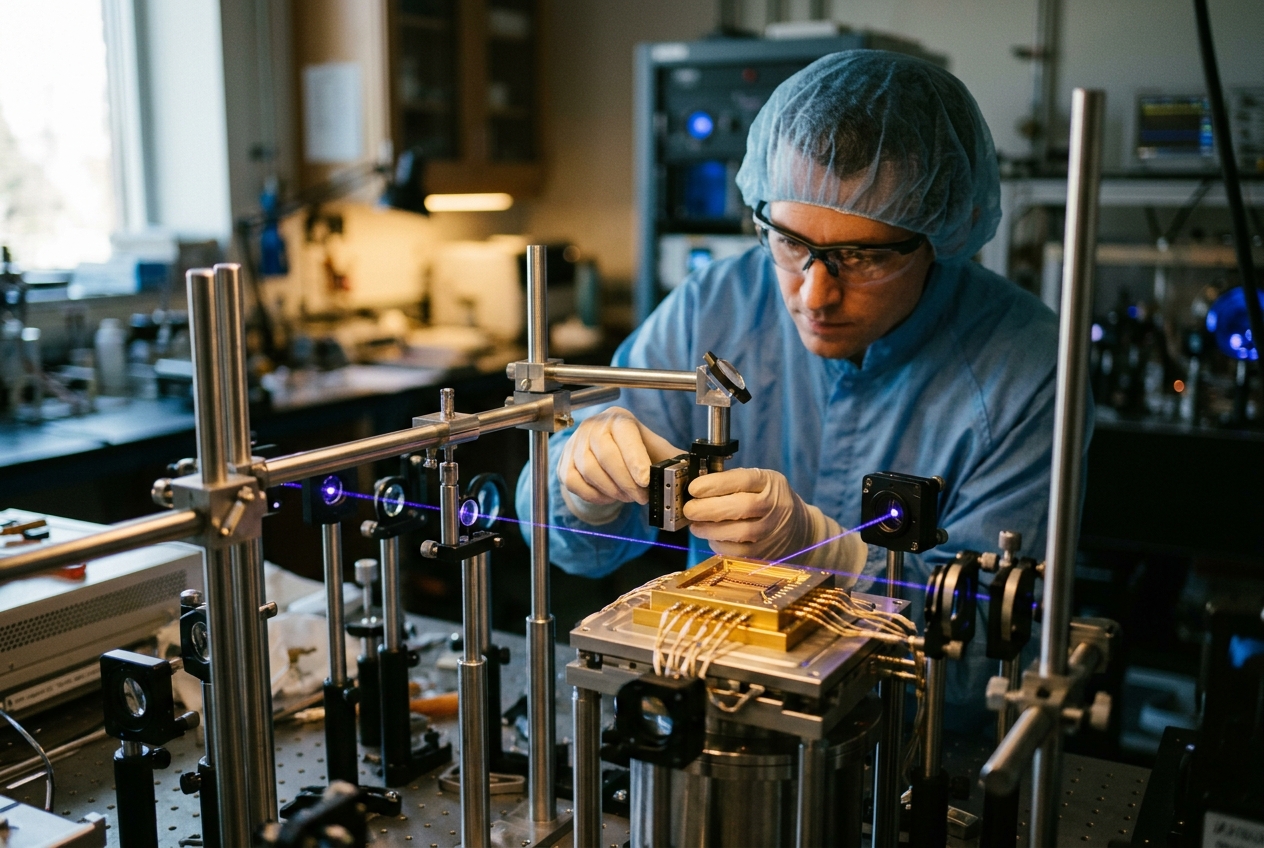
By bridging classical information theory with stabilizer quantum mechanics, the [[7, 1, 3]] CSS code proved that quantum computers could protect their delicate calculations from thermal chaos—paving the path toward fault-tolerant computation.
1. Opening Hook — Why You Should Care
Every digital interaction that defines modern civilization—from securing financial ledgers and personal communications to authenticating global power grids—relies on cryptographic architectures built on the presumed computational intractability of mathematical problems such as prime factorisation and discrete logarithms. A fault-tolerant quantum computer executing Shor’s algorithm can dismantle these defenses in mere hours. Yet, the physical machines built today are paralyzed by an existential vulnerability: quantum decoherence.
A classical bit is an unyielding mechanical switch, stored reliably as billions of electrons across semiconductor capacitors. A physical quantum bit (qubit), by contrast, is an ephemeral whisper. Whether realized as a trapped ytterbium ion vibrating in an electromagnetic trap or a superconducting Josephson junction cooled to millikelvin temperatures, a qubit is relentlessly disrupted by stray magnetic fields, fluctuating thermal phonons, and material imperfections. Left unprotected, a complex quantum calculation collapses into unrecoverable noise within microseconds.
To transform quantum computing from an experimental curiosity into an industrial engine capable of revolutionizing molecular simulation, materials discovery, and cryptography, quantum information must be shielded without being destroyed. In 1996, British physicist Andrew Steane and the duo of Robert Calderbank and Peter Shor independently resolved this paradox. Steane constructed an elegant, mathematically flawless architecture: the [[7, 1, 3]] Calderbank–Shor–Steane (CSS) code. By embedding a single logical qubit across the entangled collective state of seven physical qubits, Steane demonstrated that nature allows us to detect and purge quantum errors without ever looking at the fragile data itself.
2. The Idea in Plain English: Taming the Continuous Wave
To understand why protecting quantum information is fundamentally difficult, consider the contrast between classical and quantum failures. In a classical circuit, the only error that can occur is a bit-flip: a $0$ turns into a $1$, or a $1$ into a $0$. To fix this, classical engineers employ redundancy. By copying a bit three times ($0 \to 000$, $1 \to 111$), any lone bit-flip can be identified and corrected by taking a simple majority vote.
In the quantum domain, three formidable physical principles prevent this naive approach:
- The No-Cloning Theorem: It is mathematically impossible to make an identical copy of an arbitrary, unknown quantum state $|\psi\rangle = \alpha |0\rangle + \beta |1\rangle$. Redundancy through duplication is strictly forbidden by the linearity of quantum mechanics.
- Measurement Collapse: If you look at a qubit in superposition to check its health, you force its wave function to instantly collapse into either $|0\rangle$ or $|1\rangle$, irrevocably destroying the continuous phase information $\alpha$ and $\beta$ that gave the computation its power.
- Continuous and Phase Errors: Beyond bit-flips (represented by the Pauli operator $X$), quantum systems suffer from phase-flips (represented by the Pauli operator $Z$, where the relative plus/minus sign between $|0\rangle$ and $|1\rangle$ is reversed) and continuous rotations. A qubit does not simply flip like a coin; its state vector can drift continuously across the surface of the Bloch sphere by an infinitesimal angle $\theta$.
       Discrete Classical Bit-Flip vs. Continuous Quantum Error

       Classical Bit:         [ 0 ] ------------( Flip )------------> [ 1 ]

                                           |0>
                                            |   .  State vector drifts continuously
       Quantum Bloch Sphere:                |  /   across phase & amplitude angles:
                                            | /    E = a*I + b*X + c*Y + d*Z
                                    --------+--------
                                           /|
                                          / |
                                        |1>
Steane’s conceptual triumph was showing that quantum mechanics provides its own remedy through stabilizer measurements and digitization of errors. Because any arbitrary physical error operator $E$ on a single qubit can be expanded as a linear combination of the identity $I$ and the three discrete Pauli operators:
$$E = c_0 I + c_1 X + c_2 Y + c_3 Z \quad \text{where } Y = iXZ$$
Measuring discrete parity checks forces the continuous quantum error to collapse into one of three discrete possibilities: a pure bit-flip ($X$), a pure phase-flip ($Z$), or a simultaneous bit-and-phase flip ($Y$). By measuring collective quantum parity without probing individual qubit amplitudes, one extracts the error's exact identity—its syndrome—while leaving the protected logical state completely untouched.
3. Foundational Architecture & The Classical Lineage
The mathematical elegance of the Steane code lies in its lineage: it directly borrows the structure of the classical $[7, 4, 3]$ binary Hamming code, an optimal linear code developed by Richard Hamming in 1950.
The Dual-Containing Classical Foundation
In classical coding theory, the $[7, 4, 3]$ Hamming code encodes $k = 4$ data bits into $n = 7$ physical bits with a minimum Hamming distance $d = 3$, meaning it can detect up to two bit-flips and correct any single bit-flip. The code is completely defined by its parity-check matrix $H$, a $3 \times 7$ binary matrix whose columns are the non-zero binary representations of the integers from $1$ to $7$:
$$H = \begin{pmatrix} 0 & 0 & 0 & 1 & 1 & 1 & 1 \ 0 & 1 & 1 & 0 & 0 & 1 & 1 \ 1 & 0 & 1 & 0 & 1 & 0 & 1 \end{pmatrix}$$
A vector $c \in \mathbb{F}_2^7$ is a valid codeword if and only if $H c^T = \mathbf{0} \pmod 2$.
The crucial mathematical property exploited by Steane is that the $[7, 4, 3]$ Hamming code $C$ is dual-containing. Its dual code $C^\perp$, spanned by the rows of $H$, consists of all vectors that are orthogonal modulo 2 to every codeword in $C$. Because every row of $H$ has an even Hamming weight of 4, and the overlap (dot product) between any two rows is 2 (which is $0 \pmod 2$), every row vector of $H$ is itself orthogonal to all rows. Consequently:
$$C^\perp \subset C$$
This dual-containing property is the rigorous mathematical prerequisite for constructing a Calderbank-Shor-Steane (CSS) quantum code. It guarantees that parity-check operators constructed separately from $X$ and $Z$ Pauli matrices commute with one another on the entire Hilbert space.
Stabilizer Generators of the [[7, 1, 3]] Code
In the stabilizer formalism introduced by Daniel Gottesman and documented in Nielsen & Chuang's foundational literature, an $n$-qubit quantum code encoding $k$ logical qubits is defined as the simultaneous $+1$ eigenspace of an abelian subgroup $\mathcal{S} \subset \mathcal{G}_n$ of the $n$-qubit Pauli group that does not contain $-I$. For $n = 7$ and $k = 1$, we require $n - k = 6$ independent, commuting stabilizer generators.
Steane mapped the three rows of the classical parity-check matrix $H$ into three $X$-type stabilizer generators ($S_i^X$) to detect phase-flips ($Z$ errors), and identically into three $Z$-type stabilizer generators ($S_i^Z$) to detect bit-flips ($X$ errors):
$$\begin{aligned} S_1^X &= I \otimes I \otimes I \otimes X \otimes X \otimes X \otimes X = X_4 X_5 X_6 X_7 \ S_2^X &= I \otimes X \otimes X \otimes I \otimes I \otimes X \otimes X = X_2 X_3 X_6 X_7 \ S_3^X &= X \otimes I \otimes X \otimes I \otimes X \otimes I \otimes X = X_1 X_3 X_5 X_7 \ S_1^Z &= I \otimes I \otimes I \otimes Z \otimes Z \otimes Z \otimes Z = Z_4 Z_5 Z_6 Z_7 \ S_2^Z &= I \otimes Z \otimes Z \otimes I \otimes I \otimes Z \otimes Z = Z_2 Z_3 Z_6 Z_7 \ S_3^Z &= Z \otimes I \otimes Z \otimes I \otimes Z \otimes I \otimes Z = Z_1 Z_3 Z_5 Z_7 \end{aligned}$$
Because the binary supports of any $S_i^X$ and $S_j^Z$ overlap on either 0, 2, or 4 physical qubit positions—all even numbers—the operators commute: $[S_i^X, S_j^Z] = 0$ for all $i, j \in {1, 2, 3}$. The code space $\mathcal{C}_{[[7, 1, 3]]}$ is the 2-dimensional subspace defined by:
$$\mathcal{C}_{[[7, 1, 3]]} = \Big{ |\psi\rangle \in (\mathbb{C}^2)^{\otimes 7} \;\Big|\; S_i^X |\psi\rangle = |\psi\rangle \text{ and } S_i^Z |\psi\rangle = |\psi\rangle, \quad \forall i \in {1, 2, 3} \Big}$$
                   The [[7, 1, 3]] Steane Code Stabilizer Architecture

    Physical Qubits:      1     2     3     4     5     6     7
    -------------------------------------------------------------
    S1 (X and Z):         .     .     .     X     X     X     X   (Indices 4,5,6,7)
    S2 (X and Z):         .     X     X     .     .     X     X   (Indices 2,3,6,7)
    S3 (X and Z):         X     .     X     .     X     .     X   (Indices 1,3,5,7)
    -------------------------------------------------------------
    Logical X_L:          X     X     X     X     X     X     X   (Weight 7 or 3)
    Logical Z_L:          Z     Z     Z     Z     Z     Z     Z   (Weight 7 or 3)
Logical Basis States and Distance
The logical basis states $|0_L\rangle$ and $|1_L\rangle$ are equal superpositions of the classical codewords. $|0_L\rangle$ is formed by projecting the vacuum state $|0\rangle^{\otimes 7}$ onto the $+1$ eigenspace using the $X$-stabilizers, yielding an equal superposition of all 8 even-weight classical codewords of the $[7, 4, 3]$ Hamming code:
$$\begin{aligned} |0_L\rangle = \frac{1}{\sqrt{8}} \Big( &|0000000\rangle + |0001111\rangle + |0110011\rangle + |0111100\rangle \ &+ |1010101\rangle + |1011010\rangle + |1100110\rangle + |1101001\rangle \Big) \end{aligned}$$
The logical state $|1_L\rangle$ is obtained by applying the logical bit-flip operator $\bar{X} = X^{\otimes 7}$ to $|0_L\rangle$, which flips every bit to yield the 8 odd-weight codewords:
$$\begin{aligned} |1_L\rangle = \frac{1}{\sqrt{8}} \Big( &|1111111\rangle + |1110000\rangle + |1001100\rangle + |1000011\rangle \ &+ |0101010\rangle + |0100101\rangle + |0011001\rangle + |0010110\rangle \Big) \end{aligned}$$
The logical Pauli operators act globally across all seven physical qubits:
$$\bar{X} = X^{\otimes 7} = \prod_{k=1}^7 X_k, \qquad \bar{Z} = Z^{\otimes 7} = \prod_{k=1}^7 Z_k, \qquad \bar{Y} = i \bar{X} \bar{Z} = -Y^{\otimes 7}$$
Because the minimum Hamming weight of any non-trivial logical operator that commutes with all stabilizers but is not itself in the stabilizer group is $d = 3$, the Steane code achieves code distance $d = 3$. According to the quantum Singleton bound ($n - k \ge 2(d - 1)$), the Steane code saturates the bound for single-error-correcting CSS codes, requiring a minimum of 7 physical qubits to encode 1 logical qubit with distance 3.
4. Syndrome Extraction & Error Correction Mechanics
The operational brilliance of the CSS construction is the total decoupling of bit-flip ($X$) and phase-flip ($Z$) error diagnosis. Syndrome extraction proceeds through two completely independent cycles without back-action or phase crosstalk.
              Decoupled Syndrome Extraction Pipeline in CSS Codes

     Corrupted State       +-------------------------+
        |psi_err> -------->| Measure S_1^Z, S_2^Z, S_3^Z | ----> X-Syndrome s_X in {0,1}^3
                           +-------------------------+            (Locates bit-flips)
                                       |
                                       v
                           +-------------------------+
                           | Measure S_1^X, S_2^X, S_3^X | ----> Z-Syndrome s_Z in {0,1}^3
                           +-------------------------+            (Locates phase-flips)
                                       |
                                       v
                           +-------------------------+
                           |  Classical Decoder      | ----> Correction Operator:
                           |  Table Lookup           |       C = (X^a)(Z^b) applied to data
                           +-------------------------+
The Complete Syndrome Lookup Mechanism
Suppose a single-qubit Pauli error $E \in {X_k, Y_k, Z_k}$ strikes physical qubit $k \in {1, 2, \dots, 7}$.
-
Bit-Flip Identification ($s_X$): We measure the eigenvalues of the three $Z$-stabilizers $S_1^Z, S_2^Z, S_3^Z$. Since $Z$ commutes with $Z$ and anticommutes with $X$ ($ZX = -XZ$), a bit-flip $X_k$ flips the eigenvalue of $S_j^Z$ from $+1$ to $-1$ if and only if physical qubit $k$ is part of the support of $S_j^Z$. Assigning binary value $0$ for eigenvalue $+1$ and $1$ for eigenvalue $-1$, the measurement produces a 3-bit syndrome vector: $$\vec{s}_X = (b_1, b_2, b_3)^T = H \cdot \vec{e}_X \pmod 2$$ where $\vec{e}_X$ is the error vector with a $1$ at index $k$.
-
Phase-Flip Identification ($s_Z$): Concurrently, we measure the three $X$-stabilizers $S_1^X, S_2^X, S_3^X$. Because $X$ anticommutes with $Z$ ($XZ = -ZX$), a phase-flip $Z_k$ produces the exact binary syndrome $\vec{s}_Z = H \cdot \vec{e}_Z \pmod 2$.
-
Combined Pauli-Y Error: A $Y_k$ error is decomposed as $Y_k = i X_k Z_k$. It triggers identical, non-zero syndromes in both registers ($\vec{s}_X = \vec{s}_Z$).
Because the columns of the parity-check matrix $H$ were chosen to be the sequential binary representations of integers $1$ through $7$, the measured 3-bit syndrome integer $(b_1 b_2 b_3)_2$ directly names the exact physical index $k$ of the faulted qubit:
| Physical Error Location | Binary Support ($k$) | $X$-Syndrome $(S_1^Z, S_2^Z, S_3^Z)$ | $Z$-Syndrome $(S_1^X, S_2^X, S_3^X)$ | Recovery Operation |
|---|---|---|---|---|
| No Error ($I$) | 000 |
0 0 0 |
0 0 0 |
$I$ (No action) |
| Qubit 1 ($X_1 / Z_1 / Y_1$) | 001 ($1$) |
0 0 1 |
0 0 1 |
Apply $X_1 / Z_1 / Y_1$ |
| Qubit 2 ($X_2 / Z_2 / Y_2$) | 010 ($2$) |
0 1 0 |
0 1 0 |
Apply $X_2 / Z_2 / Y_2$ |
| Qubit 3 ($X_3 / Z_3 / Y_3$) | 011 ($3$) |
0 1 1 |
0 1 1 |
Apply $X_3 / Z_3 / Y_3$ |
| Qubit 4 ($X_4 / Z_4 / Y_4$) | 100 ($4$) |
1 0 0 |
1 0 0 |
Apply $X_4 / Z_4 / Y_4$ |
| Qubit 5 ($X_5 / Z_5 / Y_5$) | 101 ($5$) |
1 0 1 |
1 0 1 |
Apply $X_5 / Z_5 / Y_5$ |
| Qubit 6 ($X_6 / Z_6 / Y_6$) | 110 ($6$) |
1 1 0 |
1 1 0 |
Apply $X_6 / Z_6 / Y_6$ |
| Qubit 7 ($X_7 / Z_7 / Y_7$) | 111 ($7$) |
1 1 1 |
1 1 1 |
Apply $X_7 / Z_7 / Y_7$ |
Fault-Tolerant Syndrome Extraction Protocols
Directly measuring high-weight stabilizer operators such as $S_1^X = X_4 X_5 X_6 X_7$ using a single bare ancilla qubit is catastrophic for fault tolerance. If the ancilla experiences a single physical bit-flip midway through the four sequential CNOT interactions, that single fault propagates into a weight-2 data error on the data block. A distance-$3$ code cannot correct two errors; the single fault has caused an unrecoverable logical failure.
To prevent hook errors and fault propagation, two rigorous protocols are employed:
-
Shor Ancilla Verification: Instead of a single ancilla, prepare an entangled 4-qubit Greenberger-Horne-Zeilinger (GHZ) state: $$|\text{GHZ}_4\rangle = \frac{1}{\sqrt{2}}(|0000\rangle + |1111\rangle)$$ Before interacting with the data register, a fifth verification ancilla is used to check the GHZ parity. Each qubit of the verified GHZ state couples to exactly one data qubit via a transversal CNOT gate. The GHZ state is then measured in the Hadamard basis, collapsing the multi-qubit operator into a single parity bit while guaranteeing that any single gate fault during extraction can produce at most a weight-1 error in the data.
-
Steane Ancilla Extraction: Steane introduced a non-destructive method using encoded logical states. To measure all three $X$-stabilizers simultaneously, an auxiliary 7-qubit register is prepared in the logical state $|0_L\rangle$, verified, and coupled to the 7-qubit data register via bitwise transversal CNOT gates ($\text{CNOT}^{\otimes 7}$). Measuring the auxiliary block in the $Z$-basis directly yields the classical error syndrome without single ancilla bottlenecks.
5. Transversal Gate Operations & The Eastin-Knill Boundary
The primary reason the Steane code occupies a central position in quantum computing research is its algebraic symmetry. The code exhibits transversality for the entire single-qubit and two-qubit Clifford group.
Transversal Clifford Symmetries
A logical operation $\bar{U}$ is transversal if it can be implemented as a tensor product of single-qubit physical operations applied bitwise:
$$\bar{U} = U_1 \otimes U_2 \otimes \dots \otimes U_7$$
Transversal operations are intrinsically fault-tolerant: because each physical gate acts exclusively on one physical qubit within a code block, an error occurring during gate execution cannot spread to other qubits in the same block.
                   Transversal Logical Operations on the Steane Code

    Block A (7 qubits):    [q1]   [q2]   [q3]   [q4]   [q5]   [q6]   [q7]
                            |      |      |      |      |      |      |
                           (H)    (H)    (H)    (H)    (H)    (H)    (H)  ==> Logical H_L
                            |      |      |      |      |      |      |
    Block A (Output):      [q1']  [q2']  [q3']  [q4']  [q5']  [q6']  [q7']

    -------------------------------------------------------------------------

    Block A (Control):     [q1]   [q2]   [q3]   [q4]   [q5]   [q6]   [q7]
                            |      |      |      |      |      |      |
                          (CNOT) (CNOT) (CNOT) (CNOT) (CNOT) (CNOT) (CNOT) ==> Logical CNOT_L
                            |      |      |      |      |      |      |
    Block B (Target):      [q1]   [q2]   [q3]   [q4]   [q5]   [q6]   [q7]
-
Logical Hadamard ($\bar{H}$): Applying physical Hadamard gates bitwise ($H^{\otimes 7}$) interchanges the $X$-stabilizers and $Z$-stabilizers: $$H X H^\dagger = Z, \qquad H Z H^\dagger = X \implies H^{\otimes 7} S_i^X (H^{\otimes 7})^\dagger = S_i^Z$$ Because the $X$- and $Z$-generators share identical classical parity matrices ($H_X = H_Z$), the stabilizer group $\mathcal{S}$ is invariant under global Hadamard transformation. Thus: $$\bar{H} = H^{\otimes 7}$$
-
Logical Phase Gate ($\bar{S}$): The physical Phase gate $S = \text{diag}(1, i)$ maps $X \to Y$ and $Z \to Z$. Because all codewords in the classical $[7, 4, 3]$ code have weights congruent to $0 \pmod 4$ or $3 \pmod 4$, bitwise application of the adjoint phase gate implements the logical operation: $$\bar{S} = (S^\dagger)^{\otimes 7}$$
-
Logical CNOT ($\overline{\text{CNOT}}$): For two distinct 7-qubit Steane code blocks, applying transversal pairwise CNOT gates between corresponding physical qubits implements a flawless logical $\text{CNOT}$ gate between the two logical qubits: $$\overline{\text{CNOT}}{A \to B} = \bigotimes{k=1}^7 \text{CNOT}_{A_k \to B_k}$$
The Steane code therefore executes the entire Clifford group—generated by ${H, S, \text{CNOT}}$—transversally.
The Eastin-Knill Theorem and Non-Clifford Magic States
The Gottesman-Knill theorem proves that any quantum circuit restricted entirely to the Clifford group can be simulated efficiently in polynomial time on a classical computer. To achieve universal quantum computation, a quantum processor must execute at least one non-Clifford gate, such as the $\pi/8$ rotation known as the $T$-gate:
$$T = \begin{pmatrix} 1 & 0 \ 0 & e^{i\pi/4} \end{pmatrix}$$
Here, quantum error correction encounters an immovable mathematical barrier:
The Eastin-Knill Theorem (2009): No quantum error-correcting code capable of detecting arbitrary single-qubit errors can implement a universal set of logical gates using exclusively transversal operations.
Transversality preserves a continuous Lie group structure that is incompatible with the discrete nature of quantum error-correcting codes. To circumvent the Eastin-Knill boundary, the Steane code must utilize Magic State Distillation and Injection, a technique pioneered by Sergey Bravyi and Alexei Kitaev.
                       Magic State Distillation & Teleportation

       Noisy Magic States      +-------------------------+      Purified |T> State
       |T_noisy> --------------->| Distillation Routine    |------------------------+
       |T_noisy> --------------->| (15-to-1 or 5-to-1)     |                        |
       |T_noisy> --------------->+-------------------------+                        v
                                                                                +-------+
       Logical Data In |psi_L> -------------------------------------------------| CNOT  |-- (Measure)
                                                                                +-------+      |
                                                                                    |          v
                                                                             Correction: S^m Applied
                                                                                    |
                                                                                    v
                                                                       Output: T|psi_L> State
In this protocol, noisy ancillary states:
$$|T\rangle = \cos(\pi/8)|0\rangle + \sin(\pi/8)|1\rangle$$
are prepared non-fault-tolerantly and purified through an iterative distillation circuit that uses transversal Clifford operations to filter out errors. The pristine magic state is then consumed via a fault-tolerant teleportation gadget using transversal CNOT and measurement, applying the non-Clifford $T$-gate to the logical data without ever executing a non-transversal physical operation on the data register.
6. Real-World Applications & Implementations Today
The theoretical architecture of the Steane code has transitioned into active experimental execution across leading industrial and academic hardware platforms between 2024 and 2026.
+----------------------------------------------------------------------------------------------------+
|               INDUSTRIAL FRONTIERS IN STEANE CODE REALIZATION (2024–2026)                          |
+------------------------------------+---------------------------------------------------------------+
| Trapped-Ion Shuttling (Quantinuum) | Execution of multiple fault-tolerant syndrome extraction      |
|                                    | rounds with physical fidelities > 99.9% using Ba+/Yb+ ions.   |
+------------------------------------+---------------------------------------------------------------+
| Superconducting Circuits (IBM)     | Exploration of distance-3 CSS color-code geometries on heavy- |
|                                    | hex lattices and logical state teleportation pathways.        |
+------------------------------------+---------------------------------------------------------------+
| Reconfigurable Neutral Atoms       | Optical tweezer shuttling realizing transversal entangling    |
| (Harvard / QuEra / Harvard-MIT)    | gates between multiple 7-qubit CSS code blocks simultaneously.|
+------------------------------------+---------------------------------------------------------------+
1. Quantinuum (Trapped-Ion Architecture)
In peer-reviewed milestones documented by Nature, Quantinuum demonstrated repeated, real-time fault-tolerant syndrome extraction and transversal Clifford gate execution on its H1 and H2 series trapped-ion processors. Using charged ytterbium and barium ions shuttled along radio-frequency micro-trap arrays, Quantinuum realized physical two-qubit gate fidelities exceeding $99.9\%$. The all-to-all connectivity enabled by physical ion transport allows complete implementation of the 7-qubit Steane code without routing overhead, validating that a fully error-corrected logical qubit exhibits a lower error rate than its underlying physical constituents.
2. IBM Quantum (Superconducting Processors)
On its eagle and heron quantum processors, IBM Quantum has benchmarked CSS-type stabilizer extraction using superconducting transmon qubits. While planar superconducting architectures typically favor the nearest-neighbor connectivity of the 2D surface code, IBM researchers utilize Steane code subgraphs to benchmark cross-resonance gate calibration, logical state preparation, and non-destructive ancilla readout under high-density packaging.
3. QuEra Computing & Harvard University (Neutral Atom Arrays)
Using neutral atom platforms trapped in dynamically reconfigurable optical tweezer arrays, researchers at Harvard University, MIT, and QuEra Computing achieved programmatic entangling operations across multiple Steane code blocks. By physically moving arrays of rubidium atoms during circuit execution, they performed transversal CNOT gates between encoded logical blocks, executing algorithmic stabilizer decoding in real time.
4. Post-Quantum Cryptanalysis & Molecular Simulation
Industrial consortia and national laboratories are leveraging CSS stabilizer architectures to compile the precise resource counts required to simulate complex chemical catalysts—such as the nitrogenase FeMo-cofactor for carbon-neutral fertilizer synthesis. By determining the exact physical-to-logical qubit ratio and the magic-state distillation throughput required for a Steane-based fault-tolerant processor, researchers have mapped the threshold where quantum advantage moves from heuristic experimentation to mathematically guaranteed chemical precision.
7. What This Means for You & Modern Fault-Tolerant Architectures
For decades, skeptics argued that quantum computing was an experimental chimera—that physical noise would accumulate exponentially faster than quantum error correction could suppress it. The Steane code delivered the constructive mathematical proof that noise scales polynomially, while error suppression scales exponentially with code distance.
The Steane code is not merely an isolated historical milestone; it is the elementary unit cell of modern topological color codes. If you map the 7 physical qubits of the Steane code onto the vertices of a 2D triangle containing three colored plaquettes (Red, Green, Blue), the three $X$- and $Z$-stabilizers map onto the geometric faces of the lattice. Expanding this planar geometry creates higher-distance 2D color codes capable of sustaining full transversal Clifford operations across macroscopic chip areas.
Furthermore, CSS principles form the algebraic foundation of surface code lattice surgery—the primary architecture slated for commercial fault-tolerant supercomputers by 2030. When fault tolerance is realized, the practical consequences for society will be profound:
- Pharmaceutical Design: Drug discovery will shift from slow, empirical laboratory trial-and-error to exact quantum molecular simulation, modeling complex protein-ligand bindings and enzyme catalytic pathways on the logical level.
- Materials Science: Designing ambient-condition superconductors, high-energy-density solid-state batteries, and highly efficient photovoltaic cells will become deterministic computational engineering tasks.
- Data Security & Privacy: As quantum machines scale past the fault-tolerance threshold, global communications infrastructure will complete its transition to quantum-resistant lattice-based cryptography, guaranteeing mathematical security against both classical and quantum adversaries.
8. Today's Takeaway
The [[7, 1, 3]] Steane code is the foundational proof that quantum information can survive a noisy universe. By mapping the classical dual-containing Hamming code into six commuting quantum stabilizer generators, Andrew Steane proved that quantum errors can be continuously diagnosed and dismantled through discrete measurements without ever disturbing the underlying wave function. In uniting error digitization, syndrome extraction, and transversal Clifford symmetries, the Steane code transformed quantum mechanics from a delicate microscopic phenomenon into an engineered, fault-tolerant computational reality.
Further Reading & Authoritative References
- Steane, A. M. "Error Correcting Codes in Quantum Theory." Physical Review Letters, 77(5), 793–797 (1996)
- Calderbank, A. R., & Shor, P. W. "Good quantum error-correcting codes exist." Physical Review A, 54(2), 1098 (1996)
- Gottesman, D. "Stabilizer Codes and Quantum Error Correction." PhD Thesis, Caltech, arXiv:quant-ph/9705052
- Eastin, B., & Knill, E. "Restrictions on Transversal Encoded Quantum Gate Sets." Physical Review Letters, 102(11), 110502 (2009)
- Nielsen, M. A., & Chuang, I. L. Quantum Computation and Quantum Information. Cambridge University Press