Randomized Benchmarking: Quantifying Average Gate Fidelity and Clifford Error Rates in Scalable Quantum Processors
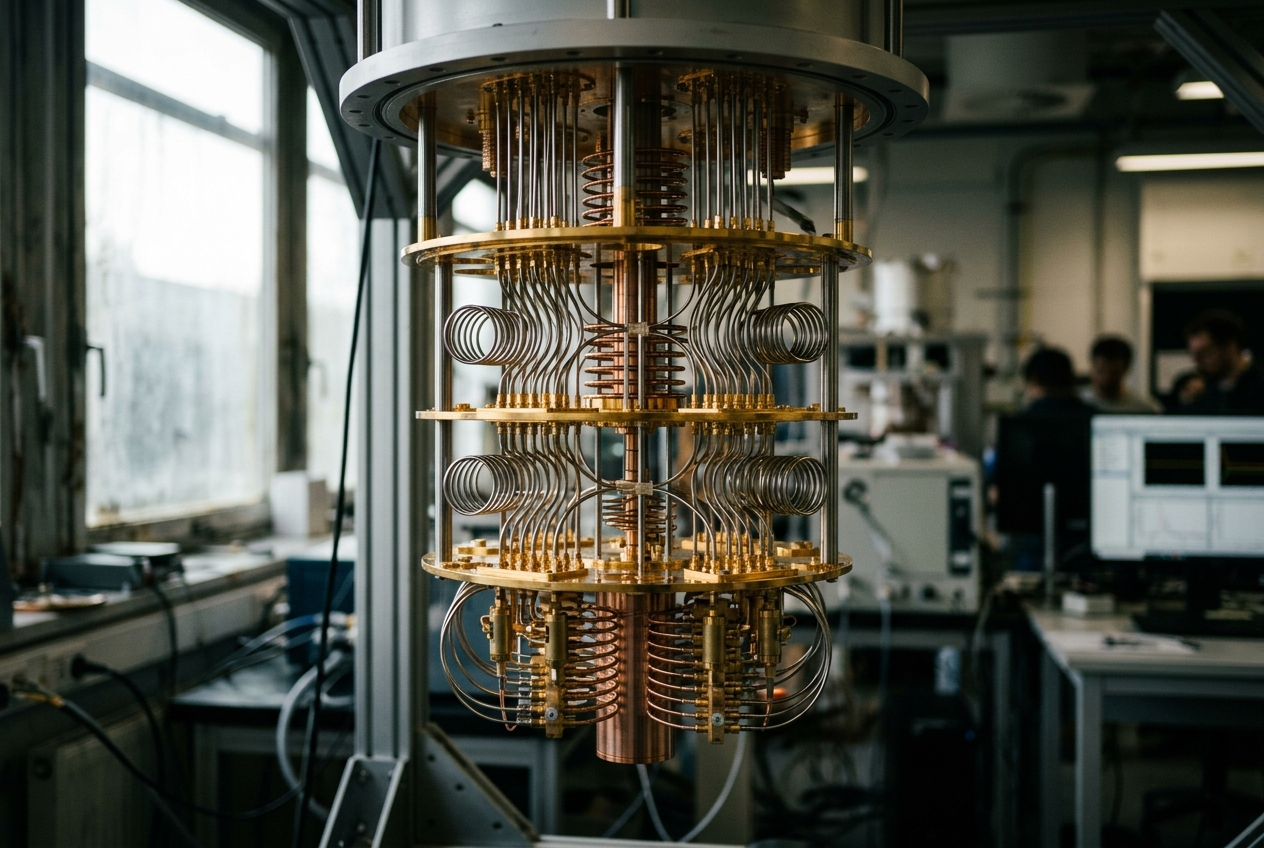
The modern race to build a functional quantum computer is often described as a quest for sheer numbers: more qubits, larger dilution refrigerators, and grander laboratory footprints. Yet beneath the corporate headlines lies a far more unforgiving reality. A machine with ten thousand quantum bits is entirely useless if every single operation performed upon them introduces a tiny, compounding sliver of error. The cryptographic algorithms that secure global banking systems, the molecular simulations designed to revolutionize pharmaceutical development, and the logistical optimizations that could reshape global supply chains all share a single prerequisite: quantum logic operations that are accurate enough to correct their own mistakes faster than those mistakes accumulate.
Without a rigorous method to measure the performance of physical quantum hardware, engineers are effectively flying blind, unable to distinguish genuine computing power from quantum noise. This analytical guide explores Randomized Benchmarking (RB)—the definitive metrological framework that allows physicists to cut through laboratory imperfections, reliably assess quantum logic gates, and chart a verifiable path toward fault-tolerant quantum computation.
1. Opening Hook — Why You Should Care
The digital security shielding your bank accounts, private medical records, and national electrical grids relies on mathematical problems that would take existing supercomputers millennia to unravel. A fault-tolerant quantum computer could, in theory, dismantle these mathematical safeguards in an afternoon. But turning that theoretical vulnerability into a physical reality requires quantum logic gates that operate with near-miraculous precision.
In classical computing, a microchip's silicon transistors switch between 0 and 1 billions of times per second with error rates so low that a single transistor might fail only once in several centuries. Quantum processors, by contrast, are extraordinarily fragile instruments. Unwanted electromagnetic whispers, minute temperature fluctuations, and stray cosmic rays can scramble delicate quantum information within microseconds.
Before scientists can build machines capable of cracking modern encryption or designing life-saving oncology drugs, they must know precisely how often their quantum operations fail. If an engineer cannot measure an error with unyielding accuracy, they cannot build an automated system to fix it. Randomized benchmarking is the mathematical stethoscope that makes this measurement possible, separating the true performance of quantum hardware from the environmental noise of the laboratory.
2. The Idea in Plain English
To understand the challenge of measuring a quantum operation, consider a simple physical analogy: flipping a coin.
A classical bit is like a coin resting flat on a table—it is decisively either heads (0) or tails (1). A quantum bit, or qubit, is akin to that same coin tossed spinning into the air. While spinning, it exists in a superposition, a state that simultaneously blends the possibilities of heads and tails until an observer reaches out, catches it against their palm, and forces it to settle into one definite outcome.
Now imagine you are tasked with testing the skill of a juggler whose job is to flip this spinning coin precisely three times before catching it. If the juggler drops the coin, you might conclude that their flipping technique is flawed. But what if the floor was slick when they picked up the coin initially? Or what if your own eyesight was blurry when checking whether it landed on heads or tails?
This is the central dilemma of quantum metrology. In physics, the act of initializing a qubit is called state preparation, and the act of reading its final state is called measurement. In real-world hardware, the preparatory step and the readout step are notoriously error-prone.
Historically, physicists evaluated quantum logic gates using a technique known as Quantum Process Tomography—a brute-force method that reconstructs every possible detail of a quantum operation. You can learn more about its foundational principles through MIT OpenCourseWare's Quantum Physics curriculum. However, process tomography suffers from two fatal flaws: 1. Conflation with SPAM Errors: It cannot distinguish between a flawed logic gate and a flawed initialization or measurement (collectively known as SPAM errors). If your measurement camera is blurry, process tomography blames the gate. 2. The Exponential Wall: As the number of qubits ($n$) grows, the number of individual experiments required to complete process tomography explodes at an exponential rate of $\mathcal{O}(4^n)$. Characterizing just a three-qubit system requires thousands of separate experimental measurements, quickly rendering the technique impossible at scale.
Randomized benchmarking circumvents both problems through an ingenious mathematical trick. Instead of testing a single gate in isolation, it subjects the qubit to a long, randomized sequence of operations that ends with a single "undo" operation designed to return the qubit to its starting position.
By observing how the qubit’s chance of returning home decays as the sequence gets longer, physicists can cleanly measure the rate of gate error while mathematically ignoring the imperfections of the starting push and the final look.
3. How It Actually Works — The Mechanics
To see why randomized benchmarking is so robust, we must examine the mechanics of the random sequence itself.
Rather than selecting arbitrary quantum gates, standard RB samples operations exclusively from the Clifford group. The Clifford group is a special mathematical set of quantum operations that map standard computational states to other easily tracked configurations. In physical hardware—such as the superconducting circuits detailed in research published in Nature—Clifford operations act as an effective randomizer.
When an engineer runs a randomized benchmarking routine, the sequence unfolds through four distinct stages:
Step 1: Sequence Generation
A sequence length $m$ is selected. The computer randomly selects $m$ Clifford gates ($C_1, C_2, \dots, C_m$) from the Clifford library.
Step 2: Inversion Calculation
Because every Clifford operation can be computed efficiently on a classical computer, the classical control system calculates the net composite operation of the entire sequence:
$$C_{\text{total}} = C_m \cdot C_{m-1} \cdots C_2 \cdot C_1$$
The system then computes a single deterministic inverse gate, $C_{\text{inv}} = C_{\text{total}}^{-1}$. If every gate in the sequence operates with absolute perfection, applying $C_{\text{inv}}$ at the end will bring the qubit precisely back to its ground state ($|0\rangle$).
Step 3: Repeated Execution and Survival Probability
The sequence of $m + 1$ gates is executed on the physical quantum processor hundreds or thousands of times. The system measures the fraction of runs in which the qubit successfully lands in the ground state. This measured value is the survival probability, denoted as $P(m)$.
Step 4: Varying Lengths and Curve Fitting
The process is repeated for many different sequence lengths $m$ (for instance, $m = 2, 4, 8, 16, 32, 64, \dots$) and across dozens of distinct random variations for each length.
As the length of the random sequence increases, the small errors introduced by each gate accumulate, causing the survival probability to decay. Crucially, the mathematical averaging over the Clifford group transforms all underlying physical noise—whether it arises from phase jitter or pulse amplitude errors—into an isotropic, uniform error model known as a depolarizing channel.
Because the noise behaves as an effective depolarizing channel, the survival probability follows an exact exponential decay curve:
$$P(m) = A \cdot p^m + B$$
In this governing equation: - $p$ is the depolarizing parameter, a number between 0 and 1 that captures how well quantum information survives each additional Clifford operation. - $A$ and $B$ absorb all the stationary state preparation and measurement (SPAM) errors, as well as the error on the final inverse gate.
Because SPAM errors only alter the vertical scaling factor $A$ and the baseline offset $B$, they have zero influence on the decay rate $p$ itself. By isolating $p$, the experimenter extracts the true, uncorrupted gate performance.
From the fitted parameter $p$, the average error per Clifford operation ($r_{\text{Clifford}}$) is determined directly by the Hilbert space dimension $d = 2^n$ (where $n$ is the number of qubits involved, meaning $d=2$ for a single qubit and $d=4$ for a two-qubit pair):
$$r_{\text{Clifford}} = \frac{d - 1}{d} (1 - p)$$
This simple formula converts an abstract statistical decay into a rigorous physical metric: the exact probability that a random Clifford operation will corrupt quantum data. For developers seeking implementation examples, the Qiskit Documentation provides open-source libraries that execute this fitting process directly on operational hardware. Comprehensive theoretical overviews can also be referenced via Wikipedia's Randomized Benchmarking Article.
Isolating Specific Operations: Interleaved Randomized Benchmarking
While standard RB yields the average error across the entire Clifford group, hardware engineers usually need to evaluate one specific high-priority gate—such as a two-qubit Controlled-NOT (CNOT), Controlled-Z (CZ), or iSWAP gate.
To isolate an individual gate $C^$, physicists use Interleaved Randomized Benchmarking (IRB). In this protocol, the target gate $C^$ is systematically slotted between every single random Clifford operation:
By comparing the faster decay rate ($p_{\text{interleaved}}$) of this interleaved sequence against the reference decay rate ($p_{\text{ref}}$) of the standard sequence, the specific gate error rate $r(C^*)$ can be cleanly extracted:
$$r(C^*) = \frac{d - 1}{d}\left(1 - \frac{p_{\text{interleaved}}}{p_{\text{ref}}}\right)$$
Real-World Vulnerabilities and Threshold Realities
Despite its elegance, randomized benchmarking faces three distinct challenges when deployed in physical laboratories:
- Subspace Leakage: Real physical systems (such as superconducting transmon qubits) have more than two energy levels. A stray microwave pulse can accidentally knock an electron out of the computational states $|0\rangle$ and $|1\rangle$ into a higher, non-computational state $|2\rangle$. Standard RB assumes the system remains within the computational subspace; unrecognized leakage breaks the depolarizing assumption and produces misleading decay curves.
- Non-Markovian and $1/f$ Noise: Standard RB theory assumes that each gate experiences independent, random noise without memory (Markovian noise). However, real hardware frequently encounters slow magnetic drifts, charge fluctuations, or low-frequency $1/f$ noise where the error on gate number 50 is correlated with the error on gate number 1. These correlations can cause the decay curve to oscillate or deviate from a pure exponential fit.
- The Surface Code Threshold: The ultimate purpose of randomized benchmarking is to confirm whether physical hardware has crossed the fault-tolerant threshold for quantum error correction. Under leading topological error-correcting codes, such as the surface code, self-correcting quantum memories become viable only when physical two-qubit gate error rates drop reliably below approximately $0.7\%$ to $1\%$ ($r_{\text{gate}} < 10^{-2}$). High-performance commercial systems aim for error rates below $0.1\%$ ($r_{\text{gate}} < 10^{-3}$) to keep the physical qubit overhead manageable.
Summary of Core Mathematical Relationships
Standard Exponential Decay: $$P(m) = A \cdot p^m + B$$ Captures ground-state survival probability across sequence length $m$, isolating SPAM noise in constants $A$ and $B$.
Error per Clifford ($r_{\text{Clifford}}$): $$r_{\text{Clifford}} = \frac{d - 1}{d} (1 - p)$$ Directly relates the fit parameter $p$ to average error rate across a Hilbert space of dimension $d = 2^n$.
Interleaved Gate Error Rate ($r(C^*)$): $$r(C^) = \frac{d - 1}{d}\left(1 - \frac{p_{\text{interleaved}}}{p_{\text{ref}}}\right)$$ Isolates the error rate of a specific targeted physical gate $C^$ from background noise.
4. Real-World Applications Today
Randomized benchmarking is not merely a theoretical construct; it is the universal benchmark used across leading quantum laboratories worldwide. Between 2024 and 2026, several hardware paradigms rely on RB to validate their technological milestones:
1. Superconducting Transmon Processors (IBM Quantum & Google Quantum AI)
Superconducting processors use tiny circuits of lithographed aluminum and niobium cooled down to near absolute zero. Companies like IBM Quantum and Google Quantum AI use automated randomized benchmarking every morning to calibrate thousands of microwave control pulses across their chips. By running interleaved RB, their compilers automatically identify deteriorating two-qubit cross-resonance gates, rerouting active quantum circuits away from sub-optimal zones of the processor in real time.
2. Trapped-Ion Quantum Computing (Quantinuum)
Trapped-ion architectures suspend individual ionized atoms in vacuum chambers using oscillating electric fields, manipulating quantum states with fine-tuned laser beams. Quantinuum uses randomized benchmarking protocols to demonstrate two-qubit gate fidelities exceeding $99.91\%$. Because trapped ions feature all-to-all connectivity, RB validates that moving an ion across the electromagnetic trap does not introduce spatial decoherence into neighboring qubits.
3. Neutral-Atom Arrays (QuEra Computing & Harvard University)
Neutral-atom systems trap hundreds of individual rubidium or ytterbium atoms in grids of laser light known as optical tweezers. High-speed entangling operations are driven by exciting atoms into oversized, highly reactive Rydberg states. Researchers at Harvard and QuEra use randomized benchmarking sequences to characterize the fidelity of these transient Rydberg interactions, confirming that large-scale atomic shuffling operations maintain quantum coherence.
4. Silicon Spin Qubits (Intel Labs & UNSW)
Silicon spin qubits trap single electrons inside nanoscale quantum dots manufactured using standard semiconductor cleanroom fabrication techniques. Intel uses automated randomized benchmarking to evaluate electron-spin exchange operations across 300-millimeter silicon wafers. RB enables their metrology teams to benchmark thousands of individual quantum dots across a single wafer, establishing a direct feedback loop with commercial chip-fabrication lines.
5. What This Means for You
It is easy to view quantum calibration as a niche concern reserved for academic physicists in white lab coats. But the speed and reliability of randomized benchmarking directly determines when quantum computing will transition from an expensive laboratory curiosity into a technology that touches your daily life.
Consider the development of new medicines. Today, developing a life-saving oncology treatment takes over a decade and billions of dollars in laboratory trial-and-error because classical computers cannot accurately simulate the complex quantum chemistry of large molecular complexes. A quantum computer running verified, fault-tolerant logic gates could simulate drug-protein bindings at the atomic level in hours, allowing researchers to design customized therapies on a computer screen rather than in a petri dish.
Similarly, the timeline for when you will need to replace your household passwords and banking certificates with post-quantum cryptography is dictated by physical gate error rates. When hardware manufacturers publish randomized benchmarking scores showing two-qubit fidelities rising from $99.0\%$ to $99.9\%$ and beyond, they are not just sharing laboratory statistics—they are providing the verifiable countdown clock for the arrival of cryptographically relevant quantum machinery.
6. Today's Takeaway
Randomized benchmarking is the foundational yardstick of modern quantum technology: by mathematically scrambling quantum operations into randomized sequences and measuring their exponential survival decay, it strips away the distorting lens of measurement noise, giving scientists the unvarnished truth about how close we are to building a genuinely fault-tolerant quantum computer.