Niwan Palace Mud Pill: Cranial Alchemical Chamber, Pineal-Epithalamic Resonance, and Upper Dantian Shen Consolidation in Classical Daoist Neidan
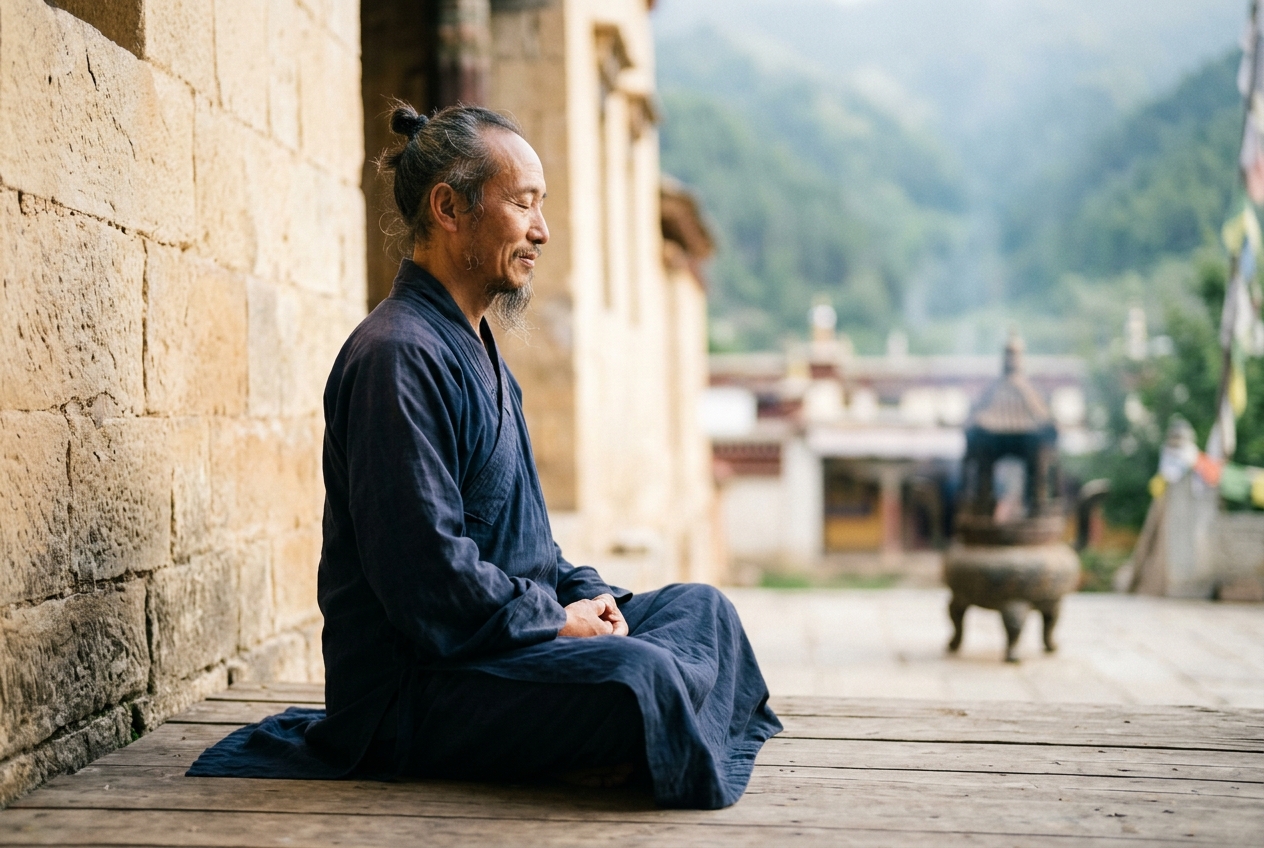
The cultivation of the Niwan Palace is an advanced internal discipline (Neidan) that requires systematic somatic setup. Attempting to concentrate energy in the head without physical grounding and fascial decompression leads to cranial tension and headaches. Follow this numbered progression carefully:
1. Establishing the Bio-Structural Root and Spinal Tensegrity
Begin seated either in a stable cross-legged posture (Siddhasana or half-lotus) on a meditation cushion, or upright on the front third of a sturdy chair with your thighs parallel to the ground. * Rock slightly from side to side until you feel your two sitz bones (ischial tuberosities) rooting firmly into the surface beneath you. * Gently tuck the tailbone slightly downward without flattening the natural curve of your lumbar spine. This engages the pelvic floor (Huiyin, CV-1) as an energetic seal. * Draw the chin back approximately a quarter of an inch in a subtle cervical retraction ("tucking the chin and hanging the crown"). This movement opens the suboccipital triangle at the base of the skull, lengthening the atlas-axis (C1–C2) junction and decompressing the jugular foramen.
2. Completing the Palatal Circuit (Queqiao / The Magpie Bridge)
Rest the entire upper surface of the front third of your tongue against the roof of the mouth, directly behind the incisive papilla. * Maintain minimal muscular force—do not push or brace. The contact should resemble a soft leaf adhering to wet stone. * This palatal connection acts as an anatomical bridge connecting the Governing Vessel (Du Mai, ascending up the spine and over the head) to the Conception Vessel (Ren Mai, descending down the front of the body), a fundamental circuit detailed by the National Qigong Association. * Relax the masseter muscles, release the lower jaw slightly downward, and allow a micro-space to exist between your upper and lower molars.
3. Inward Contemplation (Neiguan) and Optical Decompression
The optic nerves consume a large portion of our daily sensory and neural bandwidth. Engaging the Niwan Palace requires turning this sensory stream inward through Neiguan (internal observation). * Allow your eyelids to drop until they are approximately nine-tenths closed, leaving only a thin sliver of soft ambient light. * Deliberately soften the lateral rectus and ciliary muscles of your eyes. Imagine your eyeballs sinking back into their sockets by a few millimeters. * Instead of looking forward into the external room, reverse the polarity of your gaze. Invert your visual focus backward along an imaginary horizontal corridor traveling from the midpoint between your eyebrows (Yintang) straight toward the center of your skull.
4. Triangulating the Somatic Locus of the Niwan Palace
Locate the precise crucible of the Upper Dantian through dual-vector spatial awareness: * The Vertical Vector: Sense the highest point of the cranial vault (Baihui, GV-20), situated along the sagittal midline in line with the apex of your ears. Trace an invisible plumb line dropping vertically through the skull. * The Horizontal Vector: Trace a line from Yintang (between the brows) traveling backward along the transverse plane, passing through the sphenoid sinus. * The Crucible Point: Identify the exact three-dimensional point where the vertical drop from the crown intersects the horizontal beam from the brow. This locus corresponds anatomically to the third ventricle, flanked by the thalamic bodies and epithalamus (pineal gland). * Rest your mind lightly inside this coordinate. Avoid intense mental gripping; cultivate a light, spacious awareness, as if resting in the quiet center of a domed cathedral.
5. Breath Synchronization and Alchemical Transmutation (Lian Qi Hua Shen)
Synchronize this cranial presence with the movement of your breath: * Inhalation (The Draw): Inhale smoothly through the nose over a count of four to six seconds. Feel the breath descend into the lower abdomen (Xia Dantian). As the lower belly expands gently, imagine warm, refined vitality (Qi) being drawn up through the central canal of the spinal cord (Zhong Mai) via the dural sheath. * Peak Suspension (The Illuminating Pause): Retain the breath effortlessly for two seconds at the top of inhalation. Allow this ascending warmth to enter the Niwan Palace, illuminating the center of the head with a cool, clear, crystalline stillness. This represents the classical stage of Lian Qi Hua Shen—refining raw energetic vitality into clear consciousness. * Exhalation (The Grounding Descent): Exhale slowly through the nose over a count of six seconds. As you exhale, allow any excess cranial pressure or thermal energy to cascade down through the palate, down the throat, through the heart center (Zhong Dantian), and back into the storage reservoir of the lower abdomen.
+-------------------------------------------------------------------------+
|                  DIAGNOSTIC SOMATIC MARKERS & SENSATIONS                |
+-------------------------------------------------------------------------+
| SENSATION                 | PHYSIOLOGICAL & ENERGETIC MEANING           |
+---------------------------+---------------------------------------------+
| Cool, minty freshness at | Successful parasympathetic shift; dural     |
| the roof of the palate    | decompression and balanced cranial venous   |
|                           | outflow.                                    |
+---------------------------+---------------------------------------------+
| Rhythmic micro-pulsation  | Entrainment of the craniosacral rhythm and  |
| at the crown (Baihui)     | fluctuation of cerebrospinal fluid (CSF).   |
+---------------------------+---------------------------------------------+
| Golden/White internal     | Phosphenes generated via optic nerve        |
| radiance behind Yintang   | relaxation and pineal-epithalamic           |
|                           | stimulation.                                |
+---------------------------+---------------------------------------------+
| Tightness or pounding at  | CRITICAL ERROR: Cranial stagnation. Energy  |
| temples/vertex            | is trapped in the head due to poor neck     |
|                           | posture or excessive mental straining.      |
+-------------------------------------------------------------------------+
Common Beginner Pitfalls and Precise Physical Corrections
- The "Iron Crown" Error (Cranial Overpressure): Beginners often try too hard to concentrate on their third eye, which tightens the scalp and temporal muscles. This creates pressure, headaches, and energetic stagnation (Zou Huo Ru Mo).
- Correction: Immediately release focus on the head. Exhale down to the soles of your feet (Yongquan, KI-1). Place one palm over your lower belly and gently direct your attention downward until the head feels light, empty, and cool.
- Cervical Hyperextension (Collapsing the Neck): Tilting the chin upward pinches the suboccipital muscles, compresses the vertebral arteries, and impedes venous drainage through the internal jugular veins.
- Correction: Gently tuck the chin inward and lift the back of your skull upward toward the ceiling, creating length along the back of the neck.
- Palatal Clenching: Forcing the tongue against the palate with too much pressure causes tension in the sphenoid bone and deep facial muscles.
- Correction: Let the tongue rest softly against the roof of the mouth, as light as a feather resting on calm water.
Why It Works: The Anatomical and Physiological Science
The practices of Daoist internal alchemy (Neidan) often employ poetic metaphors, but their techniques produce measurable physiological changes in the body. Modern neuroanatomy, fascial biomechanics, and autonomic neuroscience help explain how these methods work:
1. Dural Membrane Tensegrity and the Craniosacral Mechanism
The central nervous system is enveloped by the dura mater—a tough, fibrous connective tissue membrane. Inside the cranial vault, the dura folds inward to create two key stabilizing structures: the falx cerebri (which separates the cerebral hemispheres along the sagittal plane) and the tentorium cerebelli (which forms a horizontal roof over the cerebellum).
When you align your posture, relax your jaw, and tuck your chin, you relieve tension along this entire dural framework. The intersection of the falx cerebri and the tentorium cerebelli forms the straight sinus, positioned right at the anatomical region of the Niwan Palace.
Decompressing these dural membranes enhances the natural, rhythmic circulation of cerebrospinal fluid (CSF). Research published via the National Center for Biotechnology Information (NCBI) demonstrates that slow, diaphragmatic breathing coupled with cranial alignment directly modulates CSF velocity and promotes metabolic clearance throughout the brain.
2. Sphenobasilar Synchondrosis and Cranial Fascial Dynamics
The sphenoid bone sits at the center of the skull base, behind the eye sockets and nasal cavity. It articulates with the occipital bone at the sphenobasilar synchondrosis (SBS). The pituitary gland rests directly within the sphenoid's central depression, known as the sella turcica (Turkish saddle).
Placing the tongue on the hard palate and softening the pterygoid muscles relieves mechanical tension across the sphenoid bone. This subtle decompression balances the tissues surrounding the pituitary and hypothalamic centers, promoting healthier baseline functioning in the autonomic nervous system.
3. The Pineal-Hypothalamic-Pituitary Neuroendocrine Axis
Daoist classics describe the Niwan Palace as the origin of inner light and the source of pure spiritual fluid (Xuan Shuang, or "Mystic Frost"). In modern biology, this corresponds closely to the neuroendocrine functions of the epithalamus and pineal gland.
The pineal gland converts serotonin into melatonin, regulating our circadian rhythms, cellular repair, and deep stages of sleep. It also produces neuroprotective trace compounds and endogenous neuromodulators that support states of deep calm.
By turning the gaze inward through Neiguan and reducing visual stimulation, we shift neural activity away from the visual cortex and reduce activity in the Default Mode Network (DMN), a brain network linked to mind-wandering and stress. Research cataloged in PubMed Central confirms that advanced meditation practices decrease DMN overactivity, producing states of deep emotional calm, focused attention, and mental clarity.
4. Autonomic Balance and Heart Rate Variability (HRV)
Slow, rhythmic breathing (roughly six breaths per minute) paired with relaxed cranial awareness stimulates the vagus nerve (Cranial Nerve X). This vagal activation slows the heart rate, lowers blood pressure, and significantly improves Heart Rate Variability (HRV).
The body enters a state of deep parasympathetic repair, shifting away from stress responses and providing the biological foundation for the internal transmutation described in Daoist alchemy.
Classical Lineage and Historical Context
The cultivation of the Niwan Palace has deep historical roots in China's esoteric traditions. The term Niwan (泥丸), literally translated as "Mud Pill," first gained prominence during the Eastern Jin Dynasty (317–420 CE) through the emergence of the Shangqing (Supreme Clarity / 上清) Daoist movement.
Scholars trace the word Niwan as an early Chinese phonetic transliteration of the Sanskrit term Nirvana (the state of transcendent liberation). However, Daoist masters also embraced its literal imagery: the physical brain was viewed as a refined, nutrient-rich clay or "mud" that houses the luminous, immaterial spirit (Shen).
The early foundation for this practice is laid out in the Yellow Court Classic (Huangting Jing, 黃庭經), a seminal text attributed to the legendary female adept Lady Wei Huacun (252–334 CE). The text maps the internal geography of the human body, dividing the brain into nine distinct chambers or "palaces," with the Niwan Palace resting at the very center as the imperial throne of consciousness:
"In the head there are nine palaces, with the Mud Pill reigning supreme at the center... Retain the breath, nourish the embryonic light, and your spirit shall attain timeless clarity."
During the Tang and Song Dynasties, Daoist masters transitioned away from laboratory-based external chemistry (Waidan, consuming metallic elixirs) in favor of internal meditative alchemy (Neidan), as comprehensively documented in Wikipedia's history of Neidan. Master Zhang Boduan (987–1082 CE), author of the alchemical classic Wuzhen pian (Awakening to Reality / 悟真篇), systematized the internal transformation of the body's Three Treasures (Sanbao):
- Lian Jing Hua Qi (煉精化氣): Transmuting raw physical vitality (Jing) in the Lower Dantian into active vital breath (Qi).
- Lian Qi Hua Shen (煉氣化神): Drawing this refined Qi up through the spine and transforming it into illuminated consciousness (Shen) within the Niwan Palace of the Upper Dantian.
- Lian Shen Huan Xu (煉神還虛): Merging the refined individual spirit (Shen) back into the vast, open emptiness of the Dao (Xu).
Through centuries of refinement, these meditative practices merged with traditional Chinese medicine and martial arts (Neijiaquan). Today, the World Health Organization's Traditional Medicine initiatives recognize these classical methods as foundational disciplines for mind-body regulation, integrative health, and preventive longevity.
Today’s Practice Commitment: The 8-Minute Morning Reset
To experience the benefits of Niwan Palace cultivation, consistency is far more important than long, exhausting sessions. Commit to this straightforward 8-minute protocol tomorrow morning before drinking coffee or looking at your phone:
- Minutes 0:00 – 2:00 (Postural Setup): Sit upright on the edge of your chair. Plant your feet, lengthen your spine, tuck your chin slightly, and rest your tongue lightly on the upper palate. Breathe naturally down into your lower abdomen to establish a grounded physical base.
- Minutes 2:00 – 6:00 (The Internal Crosshair): Soften your eyes and invert your gaze inward (Neiguan). Trace the intersection where the line dropping from the crown (Baihui) meets the line drawn straight back from between your eyebrows (Yintang). Inhale for four seconds, bringing soft warmth up the spine into this central chamber; pause for two seconds in clear stillness; then exhale for six seconds, letting all tension drain down through the body into the ground.
- Minutes 6:00 – 8:00 (Grounding and Integration): Release all visualization and internal tracking. Place both palms flat over your lower belly, beneath the navel. Breathe smoothly into your hands, ensuring that all refined energy settles securely back into the Lower Dantian.
Notice the clarity in your eyes, the open sensation across the base of your skull, and the steady, calm focus that accompanies you into the rest of your day.